Instrument Deep Dive — InterMarketEdge

Instrument Deep Dive

Full L0–L8 structural analysis on a single instrument — conviction, invalidation, and time horizon

USDCAD W33: The Bullish Thesis Is Still Waiting for Price

USDCAD W33: The Bullish Thesis Is Still Waiting for Price

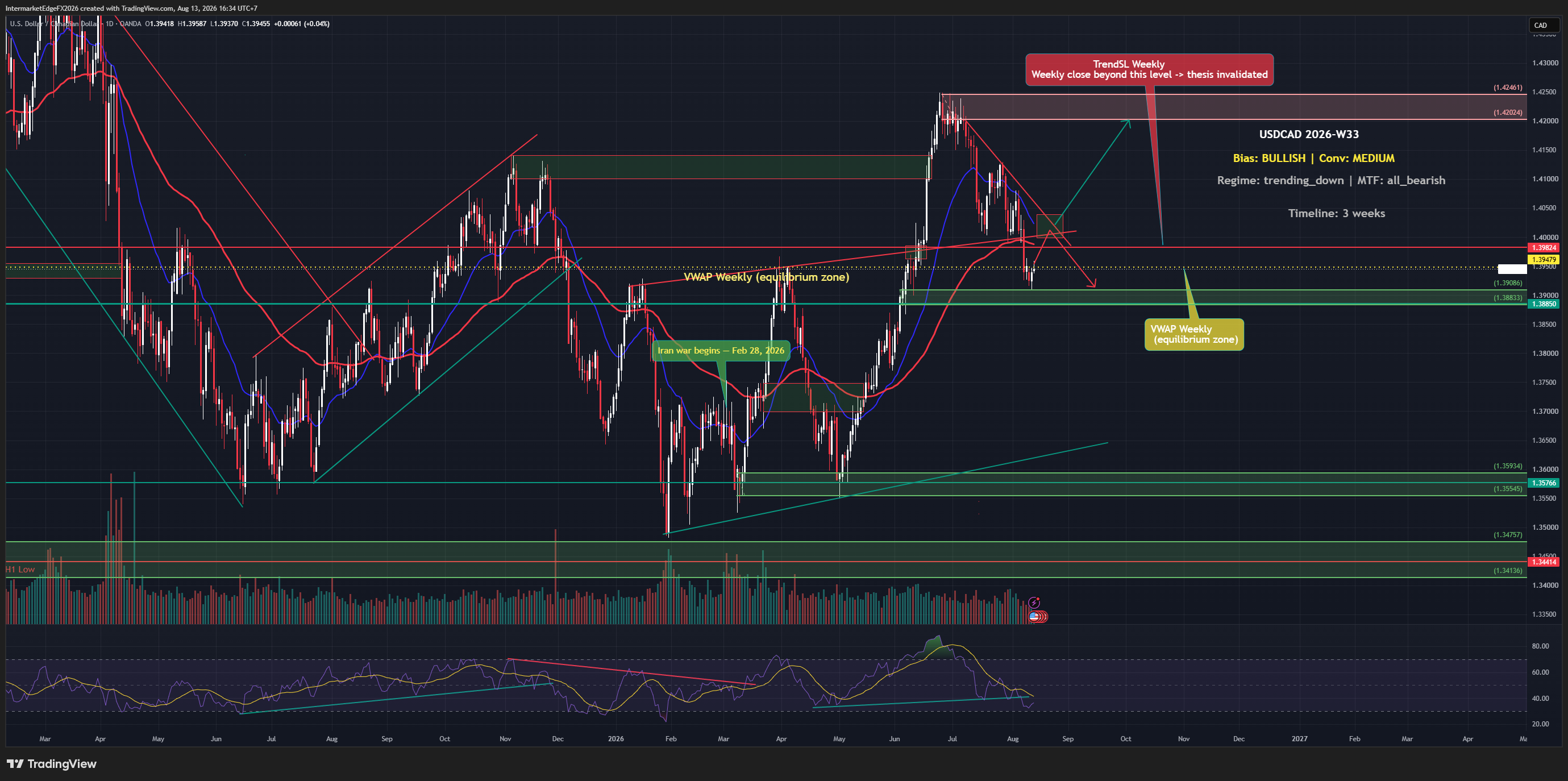
USDCAD carries a bullish bias into Week W33-2026, yet every timeframe is aligned against that label. A core CPI miss, actual 0.0% versus the 0.2% forecast, has already taken pressure off the Fed narrative, and the Canadian dollar hit a two-month high as oil prices rose. The bullish case is real but structurally unconfirmed, and that gap between label and structure is exactly where traders get hurt. The framework carries a bullish bias on USDCAD for the next three weeks at medium conviction, meaning there is a directional view, but the evidence is not strong enough to treat it as a high-confidence positioning decision. The core argument rests on two pillars: Fed hawkishness anchored by elevated real yields, and a persistent rate differential that historically favours USD over CAD. Those fundamentals have not collapsed; they have simply been pressured by this week's inflation data and Canadian-specific positive news flow. What makes this setup genuinely difficult is a structural contradiction that was present from the moment the thesis was generated: the reference price at thesis time (1.39479) was already sitting below the weekly trend stop level (1.39824). That means the bullish label was issued without technical confirmation behind it, the trend structure was already contradicting the directional call. Traders should treat this as a low-confidence rule-engine override, not a textbook bullish setup. Compounding this, COT data shows speculator positioning is at extreme short levels, a condition called crowding risk, which refers to the danger that when too many traders are on the same side, any reversal can be violent and self-reinforcing as they all exit simultaneously. That crowding raises the probability of a short squeeze (a rapid covering rally driven by stop-loss orders rather than genuine demand) that could temporarily push USDCAD lower even as the fundamental bias points higher. -- Intermarket Edge (Note: COT (Commitment of Traders) data is released weekly
GBPUSD Week W33-2026: Sterling Climbs to a One-Month High While the Bearish Macro Case Quietly Builds Against It

GBPUSD Week W33-2026: Sterling Climbs to a One-Month High While the Bearish Macro Case Quietly Builds Against It

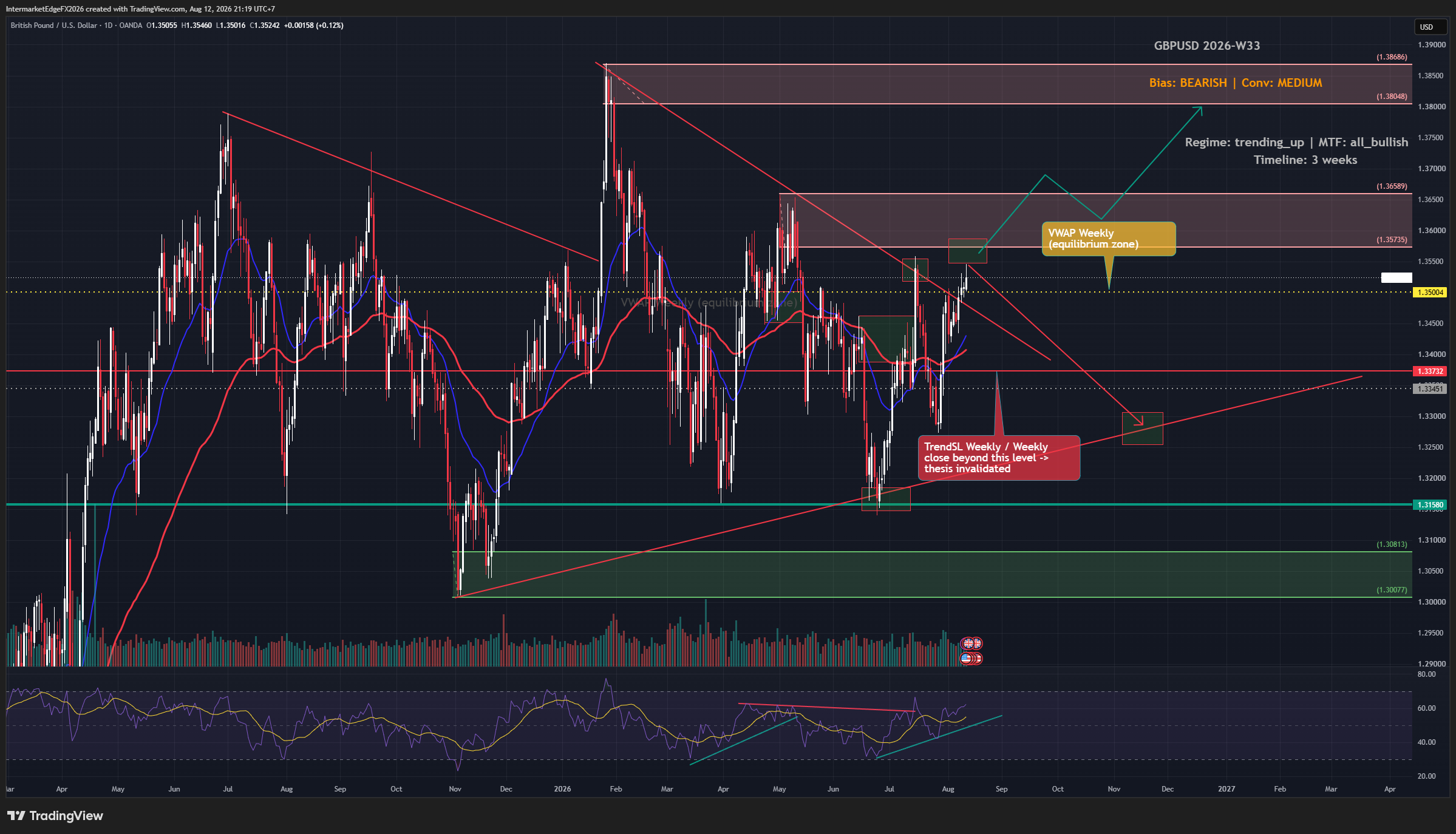
GBPUSD is trading at 1.35276 as of Wednesday, 12 August 2026, sitting above its weekly VWAP at 1.35004 and hovering near a one-month high for Sterling. A surprise Core CPI miss-actual 0.0% against a 0.2% forecast-briefly knocked the dollar's footing, but the broader macro argument for USD strength through elevated real yields hasn't structurally changed. The tension between what price is doing right now and what the macro environment implies is exactly the kind of setup that quietly catches traders off-guard. The framework's overall bias for GBPUSD this week is bearish over a three-week horizon, driven primarily by the BOE-versus-Fed rate differential-the gap between where each central bank's policy rate sits and where markets expect it to go-which currently favors the dollar because the Fed's commitment to restrictive policy is backed by real yields that remain historically elevated. When real yields are positive and rising, as the 2.4% US 10-year real yield suggests, capital tends to seek dollar exposure, which mechanically pressures currency pairs where the dollar is the quote side, like GBPUSD. Several reinforcing causal chains support this logic: Fed hawkishness sustains USD demand, and a DXY that finds its footing would directly compound downward pressure on Cable. The critical caveat-and it is not a minor one-is that the price-based and positioning-based evidence is pointing in the opposite direction. COT data (directional evidence only; the brief does not specify the report week, net-position figure, or release date, so treat this as a sentiment lean rather than a precise citable statistic) is reading bullish on Cable positioning. -- Intermarket Edge

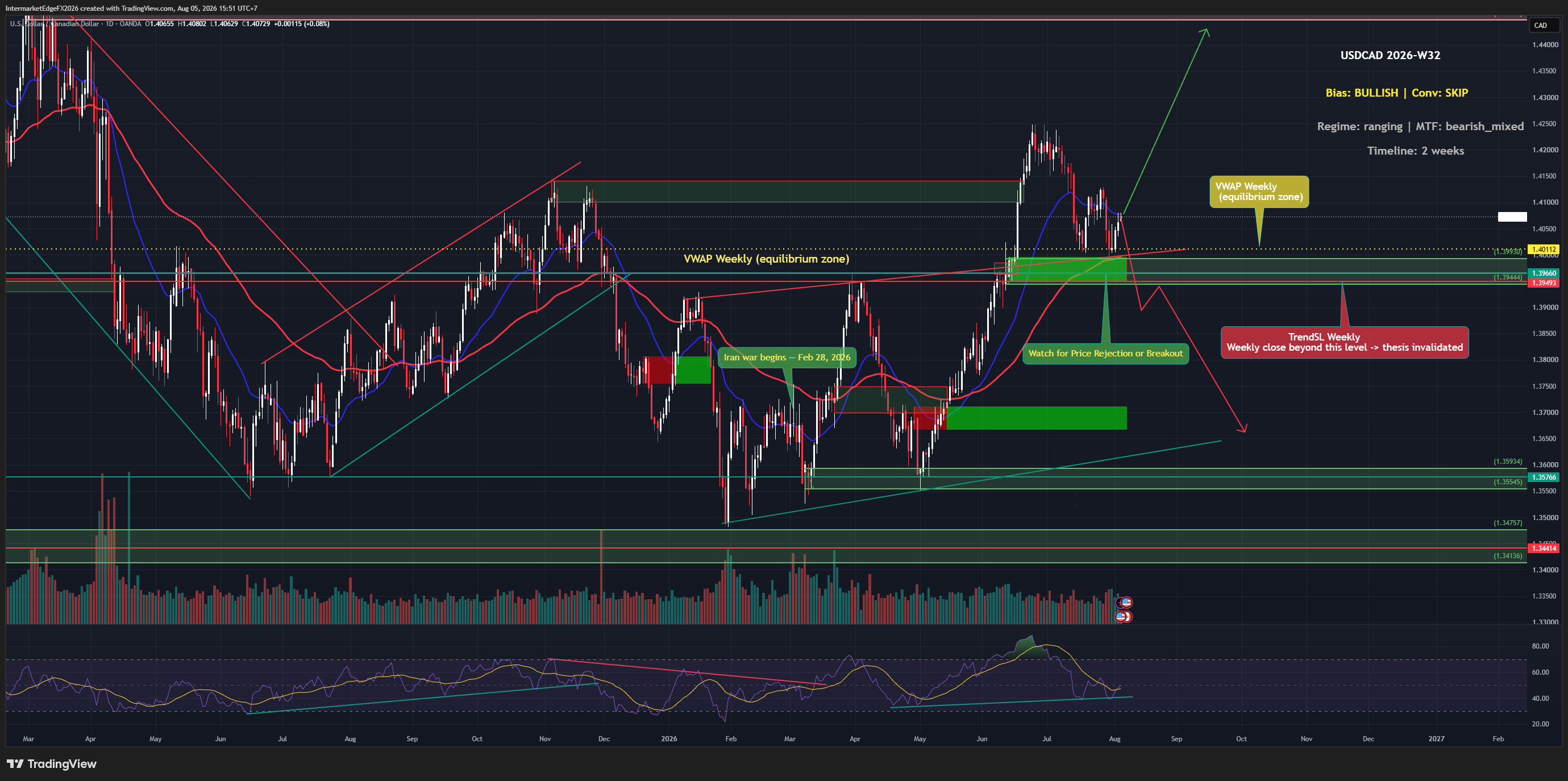
USDCAD Week W32-2026: Canadian Dollar Hits Six-Day Low as Oil Drops and Dollar Steadies Near 1.40665, but Bearish DXY Bias Keeps the Bull Case Fragile

USDCAD Week W32-2026: Canadian Dollar Hits Six-Day Low as Oil Drops and Dollar Steadies Near 1.40665, but Bearish DXY Bias Keeps the Bull Case Fragile

USDCAD is trading at 1.40665 as of Wednesday, 05 August 2026 at 08:31 UTC, holding above its weekly VWAP of 1.40112 even as the broader dollar faces pressure from Yen intervention spillover and Middle East-driven risk sentiment. The Canadian dollar recently hit a six-day low as oil prices dropped, lending short-term support to the pair. The bullish bias this week is real but fragile, conviction is low, the regime is ranging, and the macro case rests almost entirely on Fed hawkishness and rising real yields rather than any confirmed price-action breakout. The directional bias for USDCAD in Week W32-2026 is bullish, but conviction is low, a designation that carries real practical meaning for position sizing and risk management. The two active drivers supporting the upside case are COT positioning, which is skewed bullish (note: the brief does not specify the exact report week, net-position figure, or release date for this COT reading, so it should be treated as directional evidence rather than a standalone statistic), and macro fundamentals, specifically the Fed's hawkish stance and rising US real yields. The causal chain runs as follows: a hawkish Fed holding rates elevated or signaling further tightening pushes US real yields higher, which widens the rate differential between USD and CAD, making dollar-denominated assets relatively more attractive and supporting USDCAD. This is a coherent and well-established transmission mechanism in FX. However, the bullish case has a critical structural weakness: price action itself is not confirming the thesis. Momentum, liquidity, and sentiment signals are all neutral this week, meaning the market is not yet pricing in the macro story with any conviction. The multi-timeframe alignment is bearish-mixed, which is a direct caution flag, lower timeframes are not aligned with the weekly directional call. -- Intermarket Edge

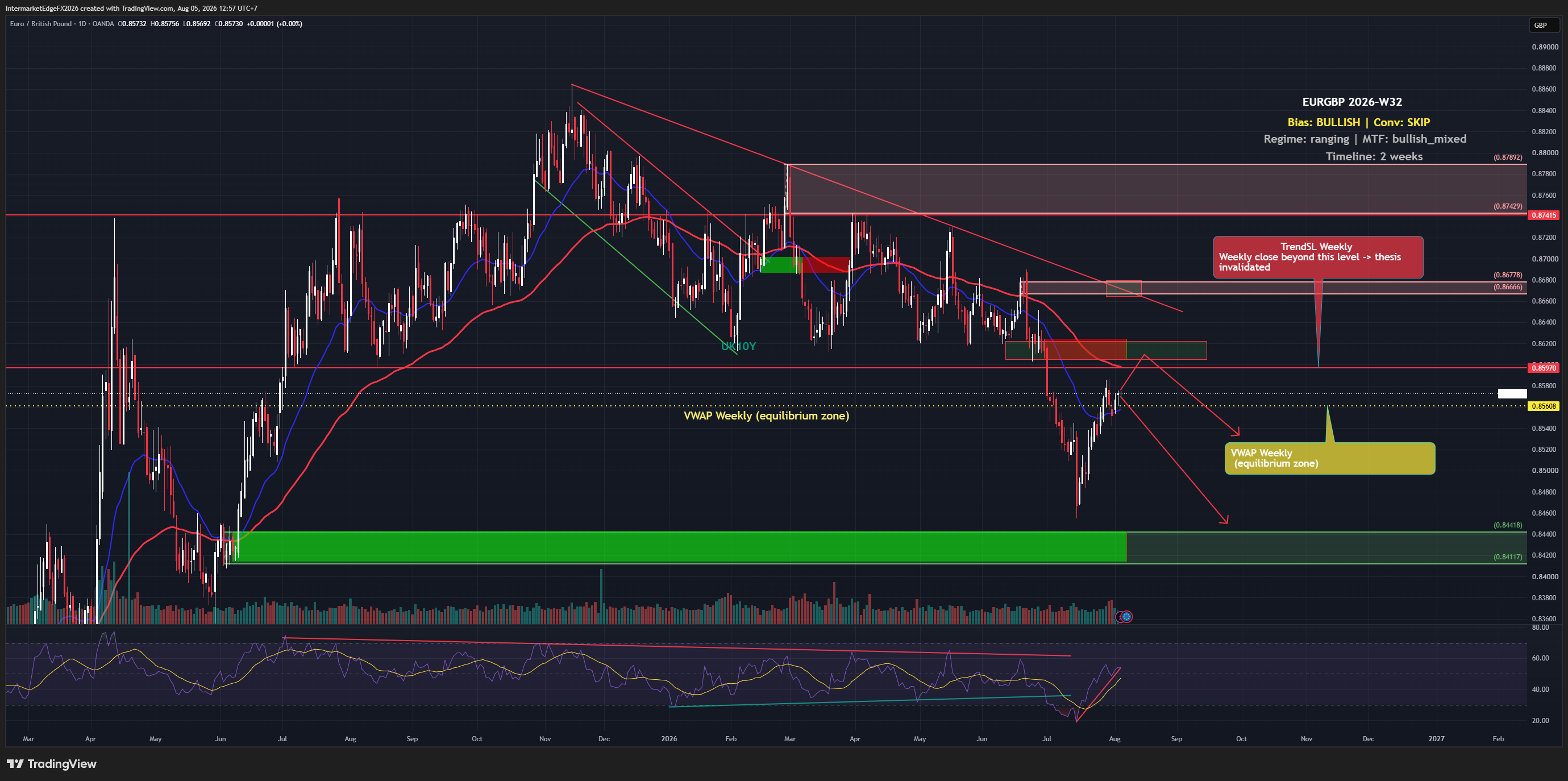
EURGBP Week W32-2026: BOE Holds at 3.75% but Bailey Pushes Back on Hike Bets, Price Tests From Underneath TrendSL 0.8597 With Conviction Too Thin to Chase

EURGBP Week W32-2026: BOE Holds at 3.75% but Bailey Pushes Back on Hike Bets, Price Tests From Underneath TrendSL 0.8597 With Conviction Too Thin to Chase

EURGBP is flashing a nominal bullish bias this week, but the setup is paper-thin. The Bank of England held rates at 3.75% on Wednesday 05 August 2026, and Governor Bailey went out of his way to shut down hike speculation, yet sterling is barely moving. With conviction at skip level and the technical structure already contradicting the directional label, this is one of those weeks where discipline means watching, not trading. The system flags a bullish bias on EURGBP for Week W32-2026, but the conviction level is explicitly rated as skip, meaning the framework itself is telling traders to stand aside rather than position. It is worth unpacking why the bullish label exists at all, and why it should be treated with significant scepticism. The sole active signal driving the directional tilt is price action; contributions from commitments of traders positioning, macro data, liquidity conditions, and sentiment are all neutral, registering zero weight. That means the bullish thesis rests on a single, thin pillar with no corroborating evidence from any other analytical lens. The stated primary driver is the ECB versus BOE rate differential, a legitimate structural theme in principle, but no macro or positioning rules have fired to confirm this narrative in the current week. There is a direct conflict between the cited driver and the absence of any supporting data firing in its favour, which should give traders real pause. Adding to the complexity, the eurozone core CPI miss removes a near-term catalyst for ECB hawkishness, while Bailey's explicit pushback on BOE hike expectations muddies the rate-differential story from the other side. Structural bias is assessed as neutral, which further undermines the weak bullish lean. -- Intermarket Edge

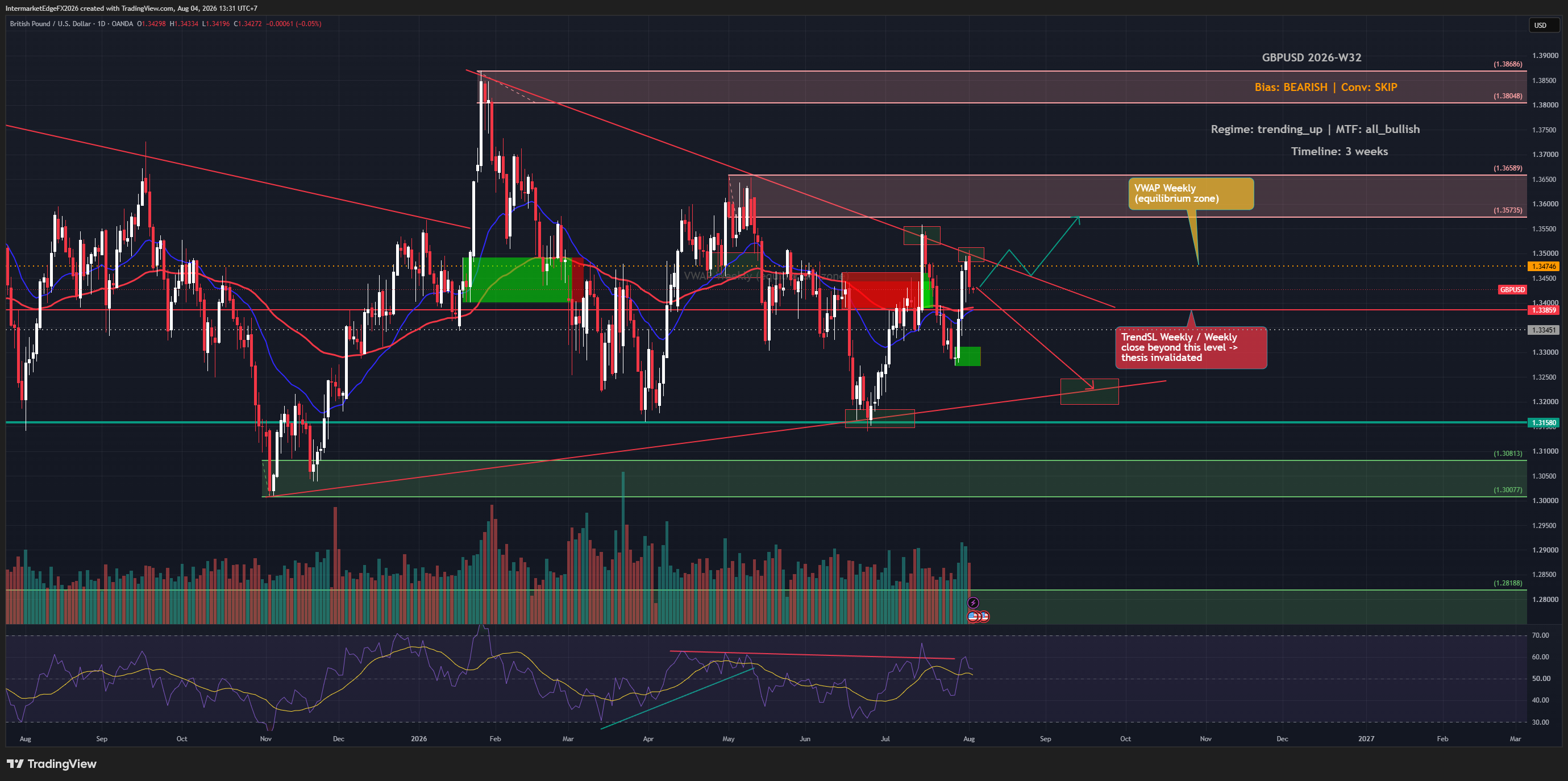
GBPUSD Week W32-2026: Sterling Slips Below 1.35 Despite Broad Dollar Weakness, Bearish Label Undercut by All-Bullish Technical Alignment Above TrendSL 1.33859

GBPUSD Week W32-2026: Sterling Slips Below 1.35 Despite Broad Dollar Weakness, Bearish Label Undercut by All-Bullish Technical Alignment Above TrendSL 1.33859

GBPUSD is caught in a genuine tug-of-war this week. The pound has slipped below 1.3500 despite broader dollar weakness, and the technical regime remains firmly bullish, yet macro headwinds from a hawkish Fed, rising real yields, and crowded long positioning in the futures market are building a credible case for downside. The honest read here is that this setup is too conflicted for a clean directional trade, and forcing a bias in either direction would be a mistake. The formal bias on GBPUSD for Week W32-2026 is bearish, but the conviction level is explicitly rated as skip, meaning this is not a setup where a position is warranted, and traders should treat that designation seriously rather than looking for a way to rationalize an entry. The bearish case rests on three macro causal chains that each carry meaningful weight: a hawkish Fed posture pushing USD higher, the core CPI miss notwithstanding; the structural linkage between DXY strength and GBPUSD downside; and Treasury General Account refill dynamics that drain liquidity from the banking system and tighten credit conditions, creating an indirect headwind for risk-correlated assets including sterling. The rate differential between the BoE and the Fed remains a focal point, if the Fed holds rates elevated while the BoE pivots or pauses, the interest rate carry shifts against GBP/USD longs over a multi-week horizon. That said, the bullish signals are not noise to be dismissed. Multi-timeframe alignment is fully bullish, price action over the recent sessions has been constructive, and the macro read independently scores bullish given pound strength driven by lingering rate-hike expectations. COT data shows speculator positioning leaning bearish, but the brief does not specify the exact report week, net-position figure, or release date, so this should be read as directional evidence rather than a precise, citable statistic. -- Intermarket Edge

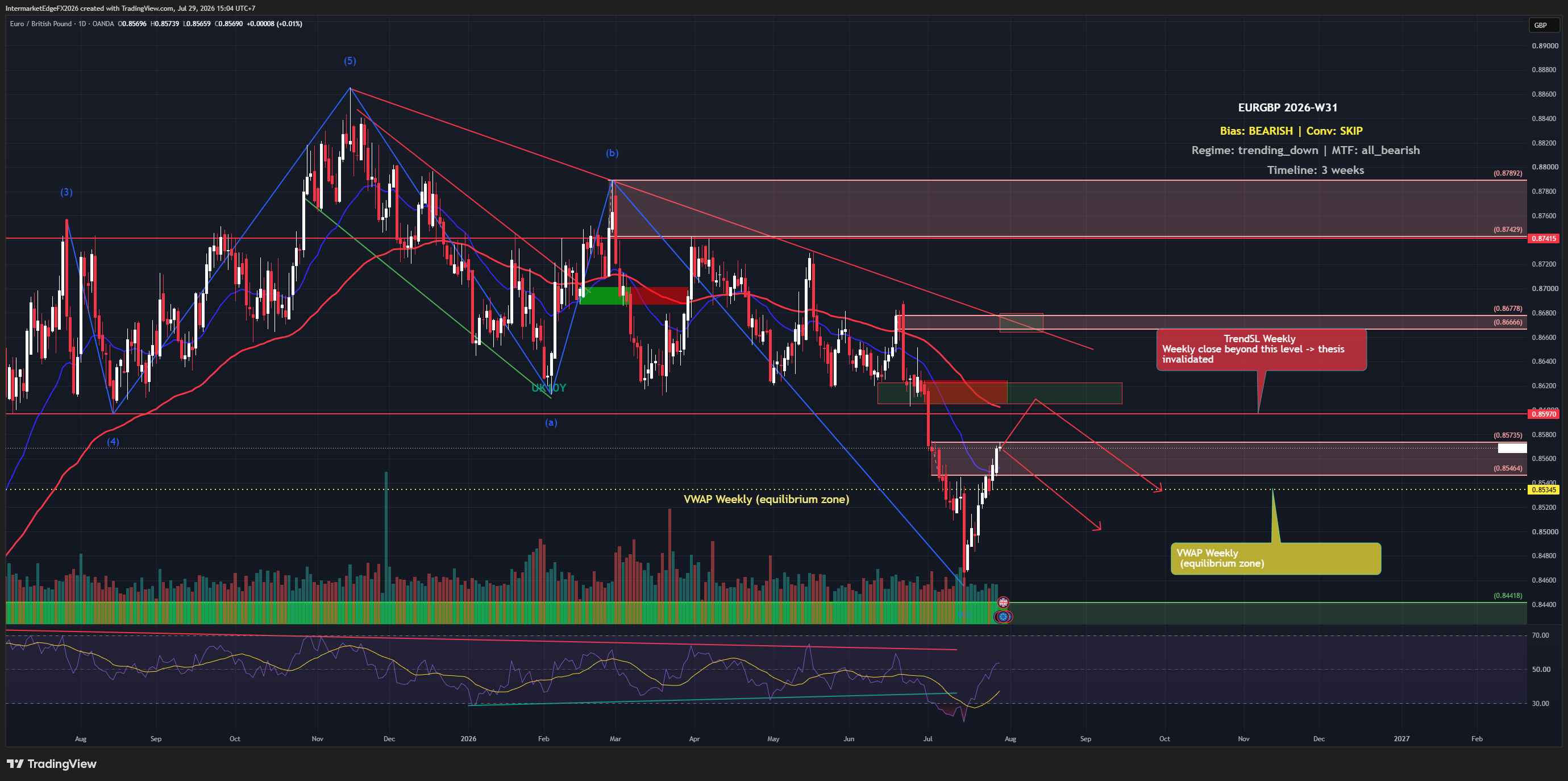
EURGBP Week W31-2026: Price Pushes Above VWAP at 0.85345 as BoE Decision Looms and ECB's Lane Flags Oil as a Medium-Sized Shock

EURGBP Week W31-2026: Price Pushes Above VWAP at 0.85345 as BoE Decision Looms and ECB's Lane Flags Oil as a Medium-Sized Shock

EURGBP is trading at 0.85703 as of Wednesday, 29 July 2026, above the weekly VWAP of 0.85345 and pressing up toward the trend stop-loss at 0.8597. The broader trend regime remains down, multi-timeframe alignment is fully bearish, and the ECB just printed a softer-than-expected core CPI reading. Yet the near-term price action is running directly against the directional bias, and conviction is low enough that sitting on the sidelines is the disciplined call right now. The structural bias for EURGBP during the week of 2026-W31 is bearish, sitting within a confirmed trending-down regime where multi-timeframe alignment is fully bearish across all measured timeframes. In a clean trending environment, the appropriate FX implication is trend-following, meaning the directional lean is to sell rallies rather than chase breakdowns. However, and this is the critical caveat that shapes the entire week's approach: conviction is too low to justify entering a directional trade at this time. The sole active signal driving any conviction this week comes from price action itself, and it is pointing bullish, running directly against the stated bearish bias. All other inputs that would normally reinforce a short case, including positioning data, macro rules, liquidity conditions, and sentiment readings, are producing no active signals at all this week. That vacuum means the bearish thesis rests almost entirely on regime classification rather than on converging, real-time evidence. The structural driver cited for the pair remains the ECB versus Bank of England rate differential, but no macro rules are currently firing to quantify or confirm how that differential is expressing itself in price this week. The ECB's softer-than-expected core CPI miss modestly shifts the rate-differential calculus in favour of sterling over the euro on the margin, which is consistent with the short-term price pressure we are observing. -- Intermarket Edge

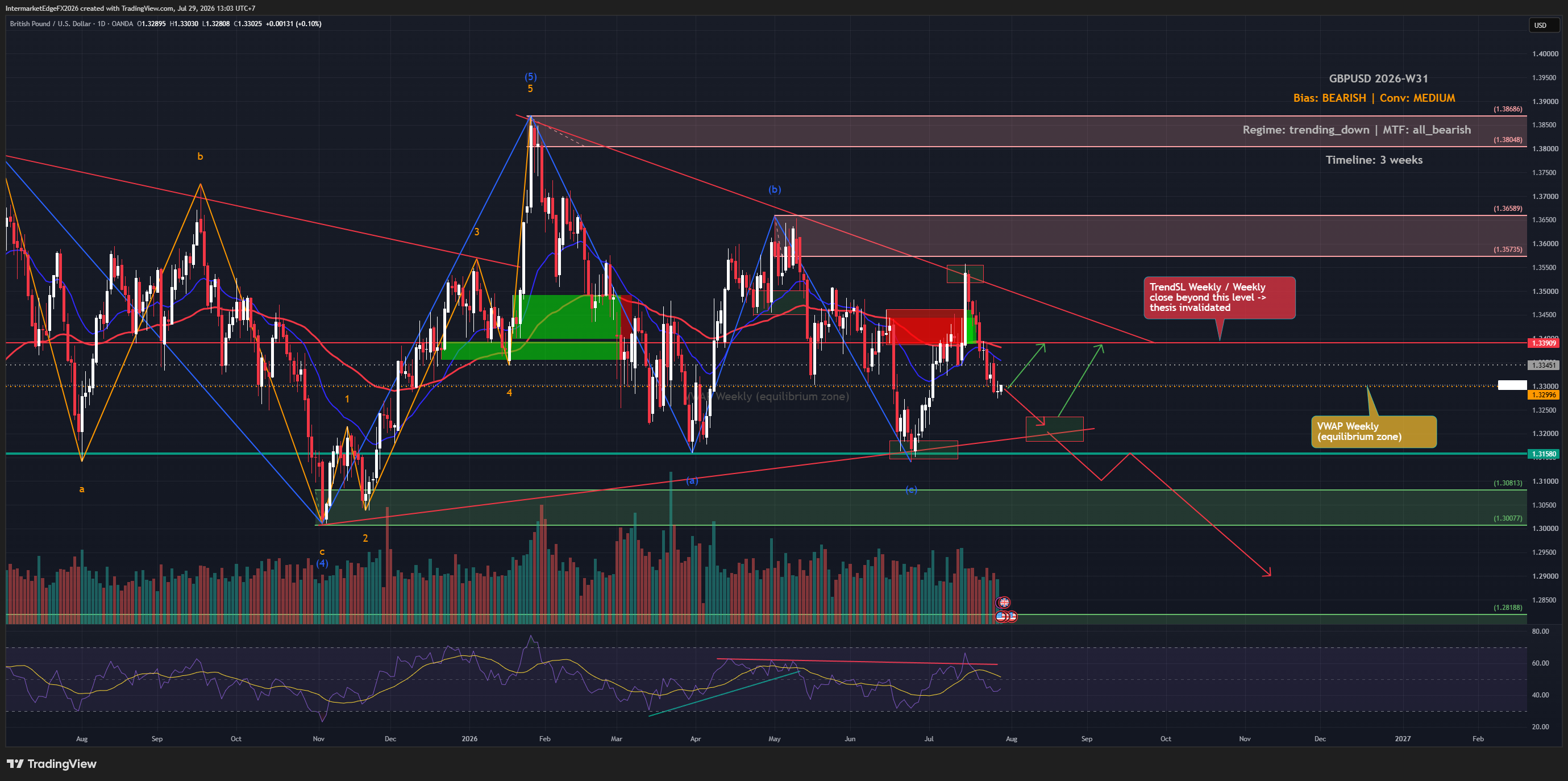
GBPUSD Week W31-2026: Sellers Push Price to Lowest Since July 2 as Fed Decision Looms and Rate Differential Widens Against Sterling

GBPUSD Week W31-2026: Sellers Push Price to Lowest Since July 2 as Fed Decision Looms and Rate Differential Widens Against Sterling

GBPUSD is trading at 1.32988 as of Wednesday, 29 July 2026 at 05:39 UTC, testing from underneath its weekly VWAP at 1.32996, a technically fragile position heading into one of the most catalyst-dense 48-hour windows of the quarter. The Fed decision, BOE rate announcement, UK GDP, and US Core PCE all land within two sessions. With multi-timeframe alignment firmly bearish and the macro rate-differential story still pointing toward USD strength, the setup demands discipline over conviction. The core bearish thesis on GBPUSD rests on a rate-differential argument: the BOE versus Fed policy divergence currently favors USD strength, with the Fed maintaining a restrictive stance anchored by elevated real yields while the Bank of England faces a more ambiguous inflation and growth environment. The Fed hawkish causal chain is the dominant driver here, a tightening bias from the Fed mechanically supports the dollar (USD bullish) and, as the quote currency in GBPUSD, exerts downward pressure on the pair. DXY bullish pressure adds a compounding secondary vector, reinforcing the USD-strength narrative from a broader basket perspective. Multi-timeframe alignment is uniformly bearish, which increases trend-follow confidence when price and structure agree with the macro backdrop. That said, the conviction level here is medium, not high, and the reason matters: there is a genuine signal conflict that traders should not dismiss. Both price action and COT positioning (directional survey data, note the brief does not specify report week, net-position figures, or release date, so this should be read as indicative rather than a precise citable statistic) are reading bullish. This means you have institutional-grade positioning and near-term price momentum potentially working against the bearish macro thesis. The practical implication is clear: this is not a setup to chase aggressively. -- Intermarket Edge

XAUUSD Week W29-2026: Breaks Below $4,000 as US-Iran Conflict Fuels Fed Rate-Hike Bets, Bullish Thesis Hangs by a Thread

XAUUSD Week W29-2026: Breaks Below $4,000 as US-Iran Conflict Fuels Fed Rate-Hike Bets, Bullish Thesis Hangs by a Thread

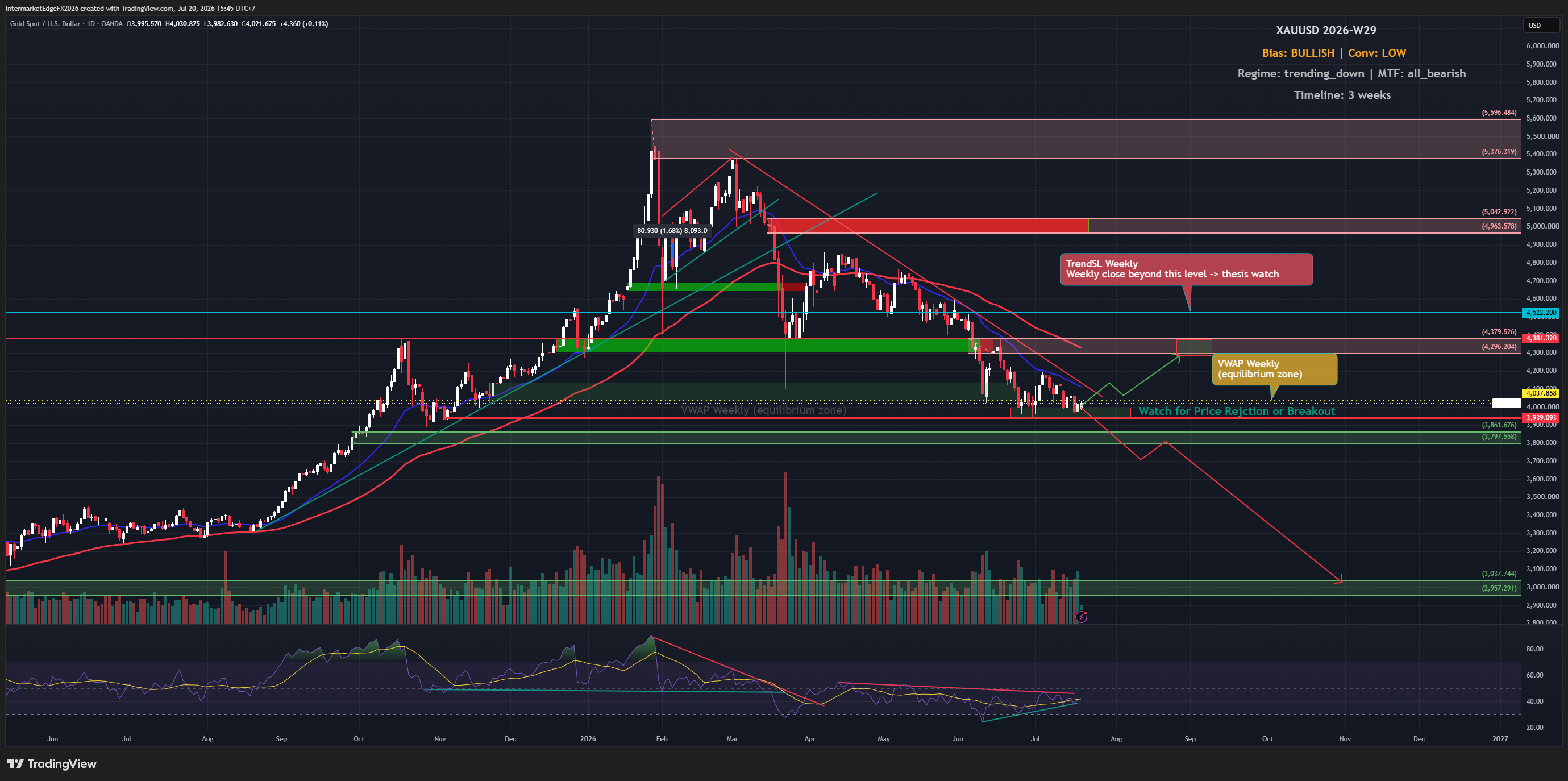
Gold closed at 3,992, slipping below the $4,000 psychological level — a technically meaningful break given price is now also under the weekly VWAP at 4,037.87. That VWAP breach is one of this framework's thesis-break conditions: price sustained below that level signals short-term momentum is running against any bullish case. The driver is counterintuitive but real: the US-Iran conflict is pushing oil sharply higher, reviving higher-for-longer inflation fears and hardening Fed rate-hike expectations. Gold, which typically benefits from geopolitical stress, is instead being sold because the war-inflation channel is hawkish, not a safe-haven trigger right now. Gold is on track for its biggest weekly loss in six weeks. This is happening despite a genuinely dovish CPI print — Core CPI MoM came in at 0.0% vs 0.2% forecast, a meaningful miss that would normally support gold via USD weakness. DXY bias is indeed bearish (low conviction), but that tailwind is being overwhelmed by the rate-hike repricing story. MTF alignment is all-bearish. Regime is trending_down (confidence 0.70), and the FX implication is trend-follow — meaning the path of least resistance is lower. COT and macro signals tilt bullish on paper, but the technical picture and recent price action are speaking louder. Overall bias is logged as bullish with low conviction — an honest reflection of conflicting signals. With price below VWAP and momentum firmly downward, this is not a long entry environment. The TrendSL at 4,522.20 is far above current price; a weekly close above that would be required to validate any bullish structural recovery — that is not a near-term scenario. Watch whether $4,000 becomes resistance on any bounce. -- Intermarket Edge

USDJPY - Yen Jumps on Intervention Fears, Last Week's Wave (a) Thesis Toward 158.953 Is Playing Out Exactly as Scripted

USDJPY - Yen Jumps on Intervention Fears, Last Week's Wave (a) Thesis Toward 158.953 Is Playing Out Exactly as Scripted

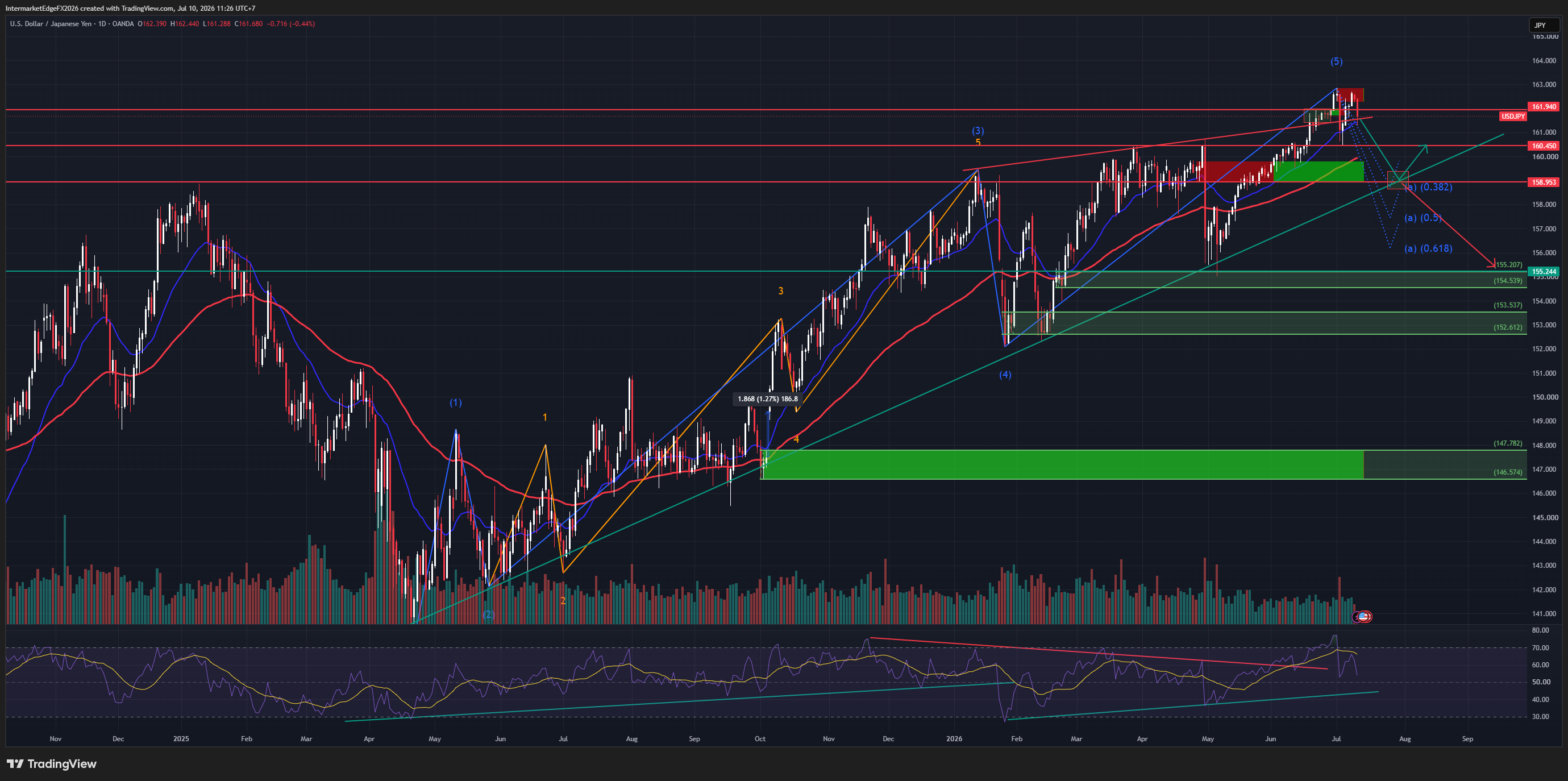
USDJPY - SUMMARY 10/07/2026 Regime: Yen jumps on MoF intervention fears, directly confirming last week's "ambush tactics" thesis. Medium Bear near-term unchanged, strongly reinforced by today's real news. Bias: Medium Bear near-term. New factors: Japan encouraging pension funds to invest domestically, June CGPI import index +29.7% y/y (seventh straight monthly rise). VIX fell 6.16% intraday, fourth straight day of cooling since the Iran shock. Data corrections: JP10Y 2.78% (not 1.47%); US-JP spread +1.76% (not the pipeline's own 3.069%). D1 structure: wave (5) peak near 163, now in corrective wave (a), broke through 160.450-161.940 (now resistance), testing 161.55-161.58 just below invalidation 161.940. Target: 158.953, 157, 155.207-154.539. Scenarios: continued decline toward 158.953-157 (45%); range pending confirmation (35%); extended decline toward 155.207-154.539 (15%); bounce invalidating the thesis (5%). Close monitoring of official MoF or BoJ statements needed in coming days. For informational purposes only, not investment advice.

Stay in the loop

Get notified about new research, macro insights, and market analysis.

InterMarketEdge

© 2026 InterMarketEdge. Financial intelligence for inter-market traders.