Macro Regime — InterMarketEdge

Macro Regime

Regime-level analysis — stagflation, Fed policy shifts, and structural macro drivers moving markets

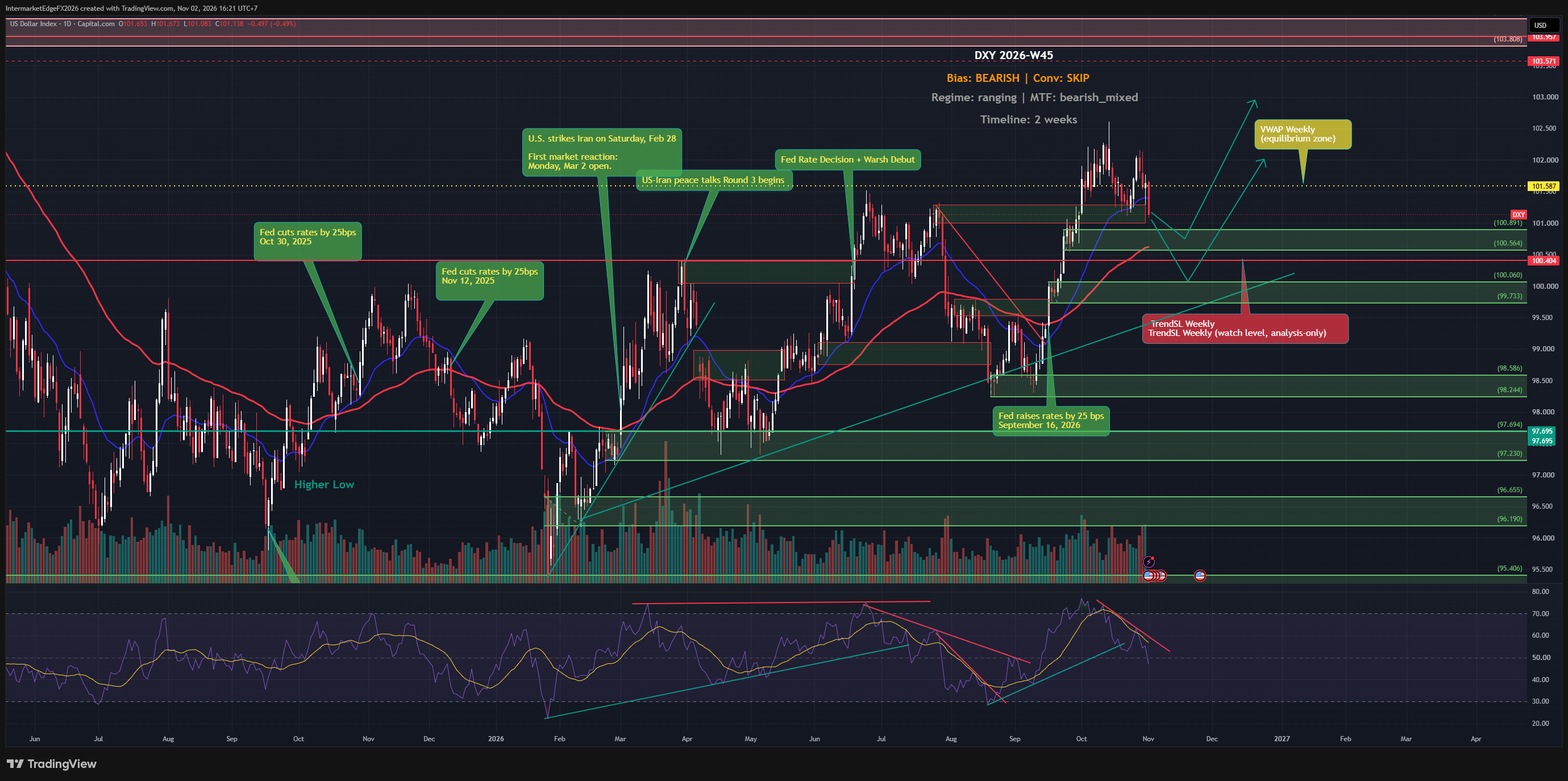
DXY W45: A bearish view still needs structural confirmation

DXY W45: A bearish view still needs structural confirmation

DXY W45: bearish, two-week horizon; stand aside for new positions. DXY was 101.444 at 2026-11-02 09:12:00 UTC, from yfinance:DX-Y.NYB:1m. Price was below weekly VWAP 101.587 and above weekly TrendSL 100.404. The structural conflict with the bearish assessment is already active. If price sustains above weekly VWAP 101.587, reduce existing short exposure; this momentum warning remains pending. A weekly close below TrendSL 100.404 would deliver the first bearish structural confirmation, not invalidation. That confirmation remains pending. No daily or weekly close is added to the VWAP condition. Neither condition automatically authorizes a new trade: the current decision is to stand aside. Fed held 3.75-4.00% on 28 October (10-2 vote); BEA on 29 October reported Q3 GDP +3.4% annualized and September core PCE +3.1% y/y. Growth and inflation leave a counter-case to dollar weakness. ForexFactory lists elections on 3 November and jobs data on 6 November; both remain pending. Intermarket Edge | Educational information, not financial advice.
DXY: An upward structure meets an active momentum warning

DXY: An upward structure meets an active momentum warning

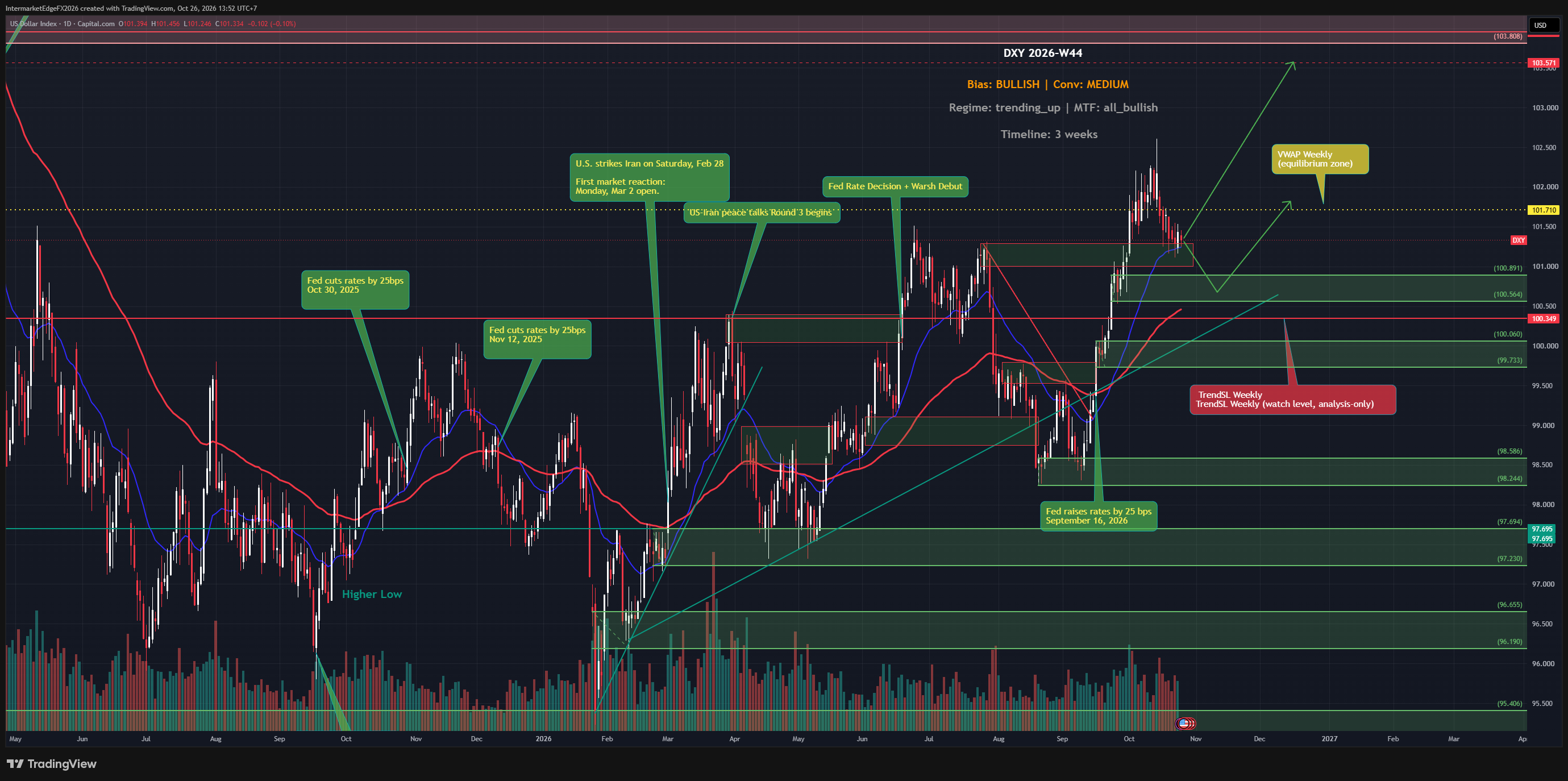
DXY W44: bullish, 3-week horizon; wait for clearer agreement before new exposure. medium confidence. Price 101.699 at 2026-10-26 06:40:00 UTC, below VWAP 101.710 and above TrendSL 100.349. Source yfinance:DX-Y.NYB:1m. Momentum warning already active: reduce existing long exposure now. A weekly close below TrendSL 100.349 would invalidate the structure; exit exposure and reassess. No daily/weekly closing rule is added to the VWAP watch. COT CFTC 098662 Leveraged Funds, report date 2026-10-20: futures only, 18,063 long / 14,880 short, net long 3,183; weekly change +1,107 contracts. Lagged futures cross-check positioning against price; release date unverified. FXSSI 40.94% long / 59.06% short, collected 2026-10-26: contrarian context near-balanced; prioritize price/yields. Broker sample. USD share derived from component pairs. CNN 21/100 (2026-10-23): extreme fear. VIX 19.45 (2026-10-23): moderate expected volatility. Defense can support USD; check breadth across pairs. FRED 2026-10-21: liquidity proxy changed $+8.29bn/4 weeks; more available liquidity can ease marginal funding. Intermarket Edge | Educational information, not financial advice. Fed on 28 October and GDP/PCE on 29 October (US dates; ForexFactory calendar) can reprice rates. Michigan sentiment 48.0 versus September 48.1, with one-year inflation expectations 4.7% versus 4.6%, leaves weak confidence alongside sticky inflation concerns.
DXY W43: Euro Weakness Supports a Dollar With Fragile Momentum

DXY W43: Euro Weakness Supports a Dollar With Fragile Momentum

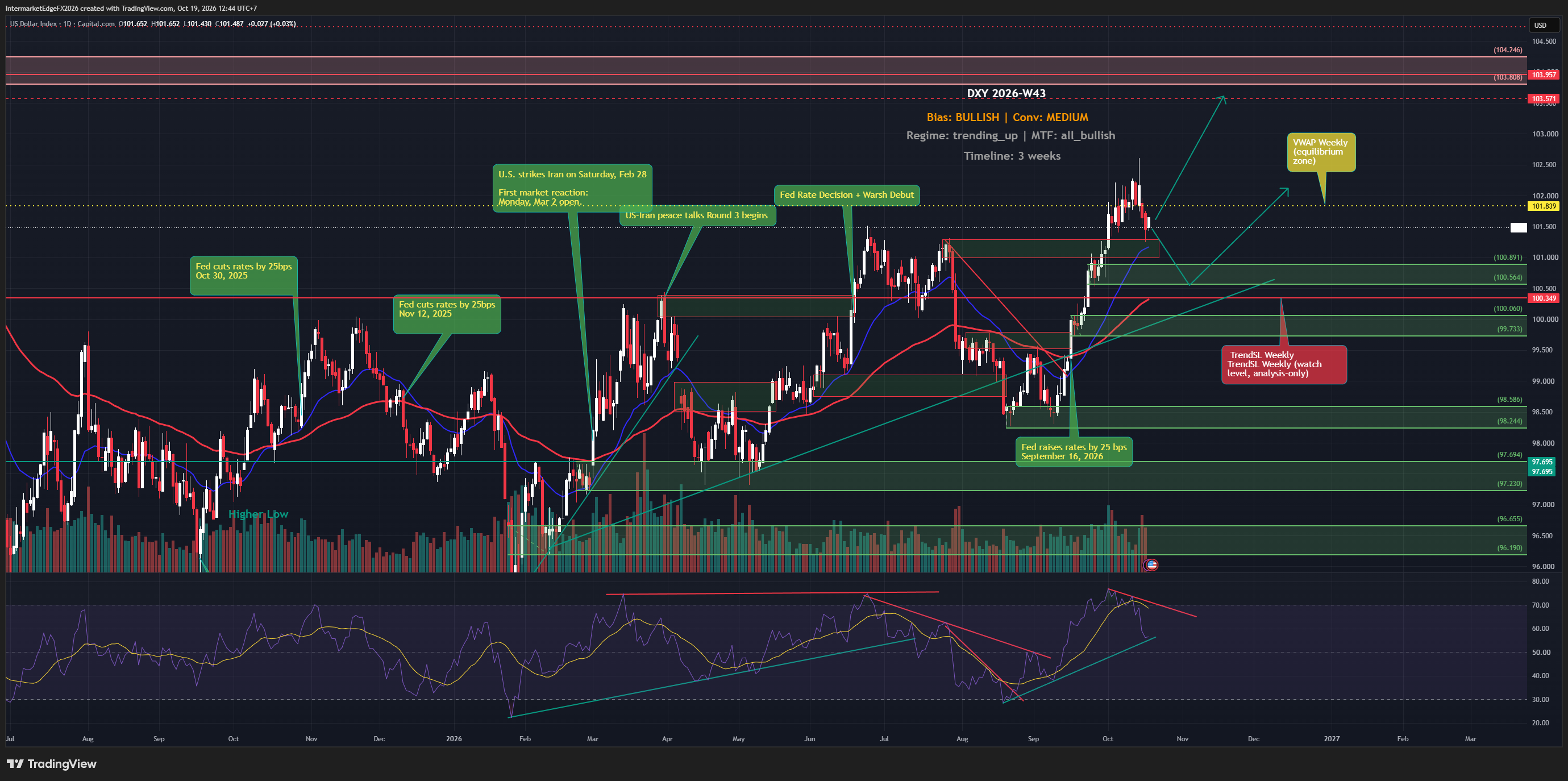
DXY W43: An upward structure with an active momentum warning. At 05:15 UTC on 19 October 2026, DXY was 101.811, below weekly VWAP 101.839 and above weekly TrendSL 100.349. Source: yfinance:DX-Y.NYB:1m. This is a timestamped observation, not a live quote. The momentum warning is already active: price is below the weekly average, so existing long exposure warrants reduced size and risk reassessment now. Structural invalidation remains pending: a weekly close below TrendSL 100.349 would invalidate the bullish structure. An intraday dip does not satisfy that weekly closing condition. Reuters on 19 October reported EUR weakness following unrest in France and softer Treasury yields alongside falling oil and AI funding concerns. Euro weakness can support the index without proving broad USD strength. Fading Fed hike expectations reported on 16 October are prior-week context that needs updating. The three-week view remains bullish with medium confidence. New positions can wait for better agreement. A sustained recovery around the developing weekly average would ease the momentum warning; no daily or weekly closing requirement is attached to that watch. Compare yields across countries before making a relative-rate claim. Intermarket Edge | Institutional Macro & Intermarket Analysis For informational and educational purposes only. Not financial advice.

DXY W42: Inflation Week Tests an Unconfirmed Bearish View

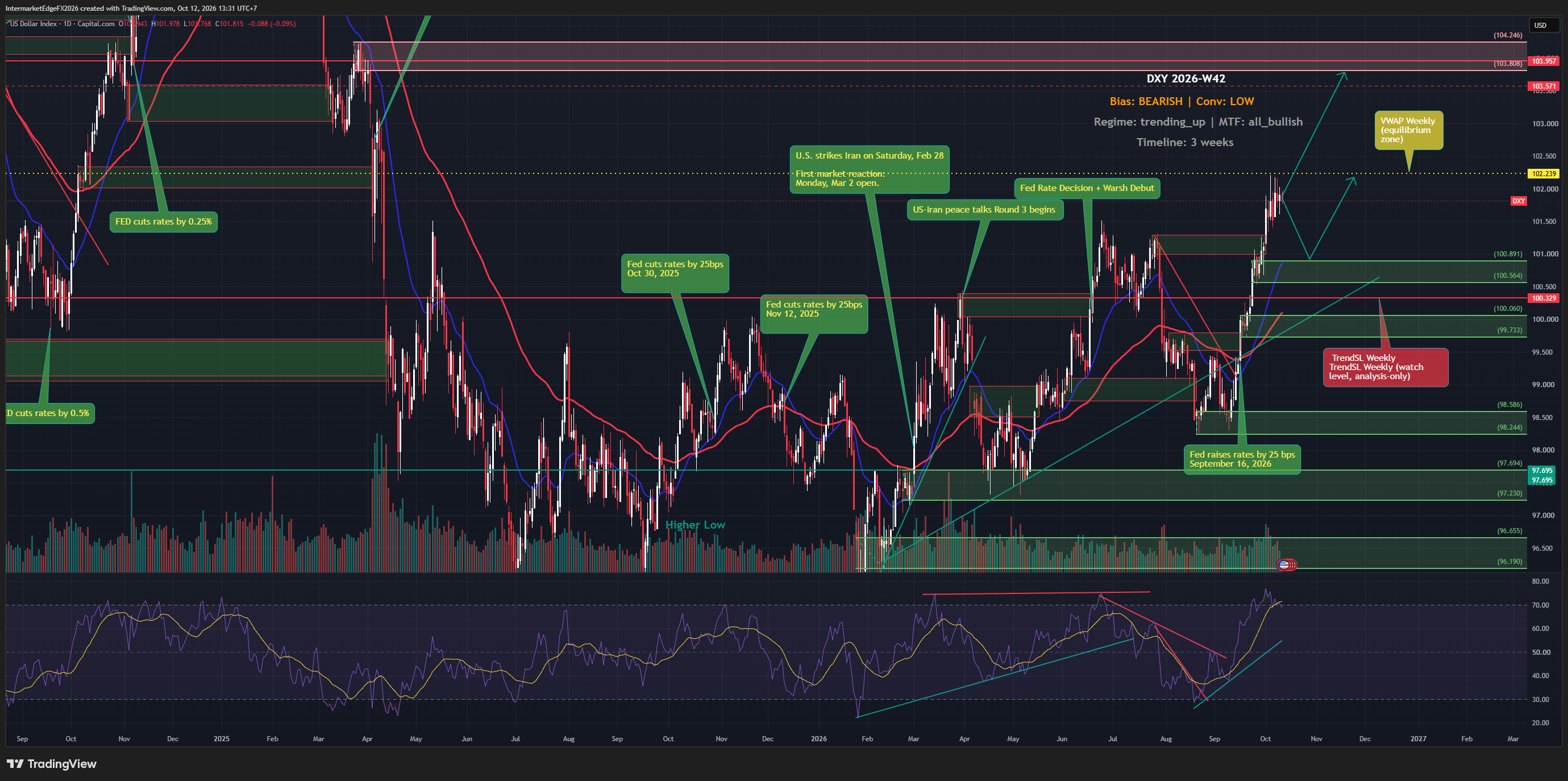
DXY W42: Inflation Week Tests an Unconfirmed Bearish View

DXY W42 retains a bearish view with low confidence over three weeks, but daily, weekly and monthly trend assessments remain upward. The technical conflict is already active. At 12/10/2026 06:15 UTC, DXY was 102.218, below weekly VWAP 102.239. Price is already above weekly TrendSL 100.329. Source: yfinance:DX-Y.NYB:1m, a timestamped one-minute observation. A completed weekly close below 100.329 would provide bearish structural confirmation. This condition remains pending; an intraday move is not a completed weekly close. Sustained strength on the higher side of the weekly average would work against the bearish view. This momentum watch has no weekly-close requirement. A one-minute quote cannot establish sustained acceptance. Reuters on 12 October highlighted upcoming US inflation data and uncertainty around oil supply. ForexFactory lists CPI on 14 October, retail sales and PPI on 15 October, and a Fed Chair appearance on 16 October; it is a secondary calendar source. Monitor oil, EURUSD and yields together. Waiting for clearer agreement avoids confusing a directional view with an entry signal. --- Intermarket Edge | Institutional Macro & Intermarket Analysis For informational and educational purposes only. Not financial advice.

DXY W41: Softer US Jobs Meet a Weaker Euro

DXY W41: Softer US Jobs Meet a Weaker Euro

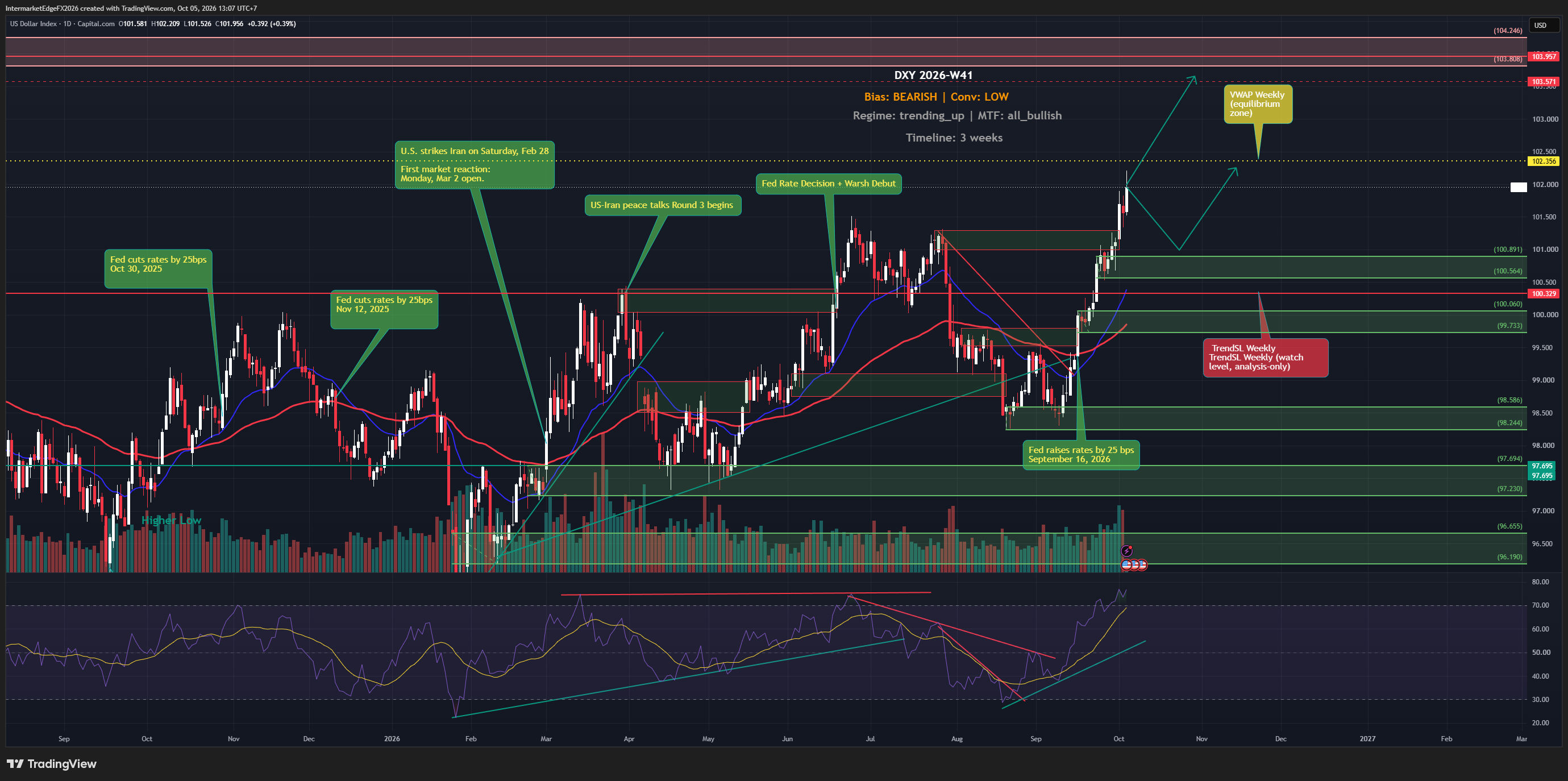
Weaker US hiring has reduced expectations of an October Fed increase, while French fiscal concerns are weighing on the euro. Those forces pull DXY in opposite directions: a less supportive US policy outlook versus weakness in the index's largest currency component. At 05/10/2026 05:55 UTC, DXY was 102.350 (source: yfinance:DX-Y.NYB:1m). Price was effectively at weekly VWAP 102.347 and above weekly TrendSL 100.329. Near-term momentum is balanced around the weekly average; a decisive move is not established. The broader trend assessment remains upward across daily, weekly and monthly charts at thesis generation. The bearish view therefore carries low confidence over the three-week horizon. Two references matter: • Weekly VWAP is a momentum reference, not an automatic structural break. A sustained recovery on its higher side would work against the bearish view. • Price is already above weekly TrendSL. A completed weekly close below 100.329 would provide bearish structural confirmation. That condition remains pending; an intraday move cannot activate it. -- Intermarket Edge

EURUSD Week W40-2026: Dollar Posts Its Largest September Gain at the Euro's Expense, But the Real Trap Is What Comes Next

EURUSD Week W40-2026: Dollar Posts Its Largest September Gain at the Euro's Expense, But the Real Trap Is What Comes Next

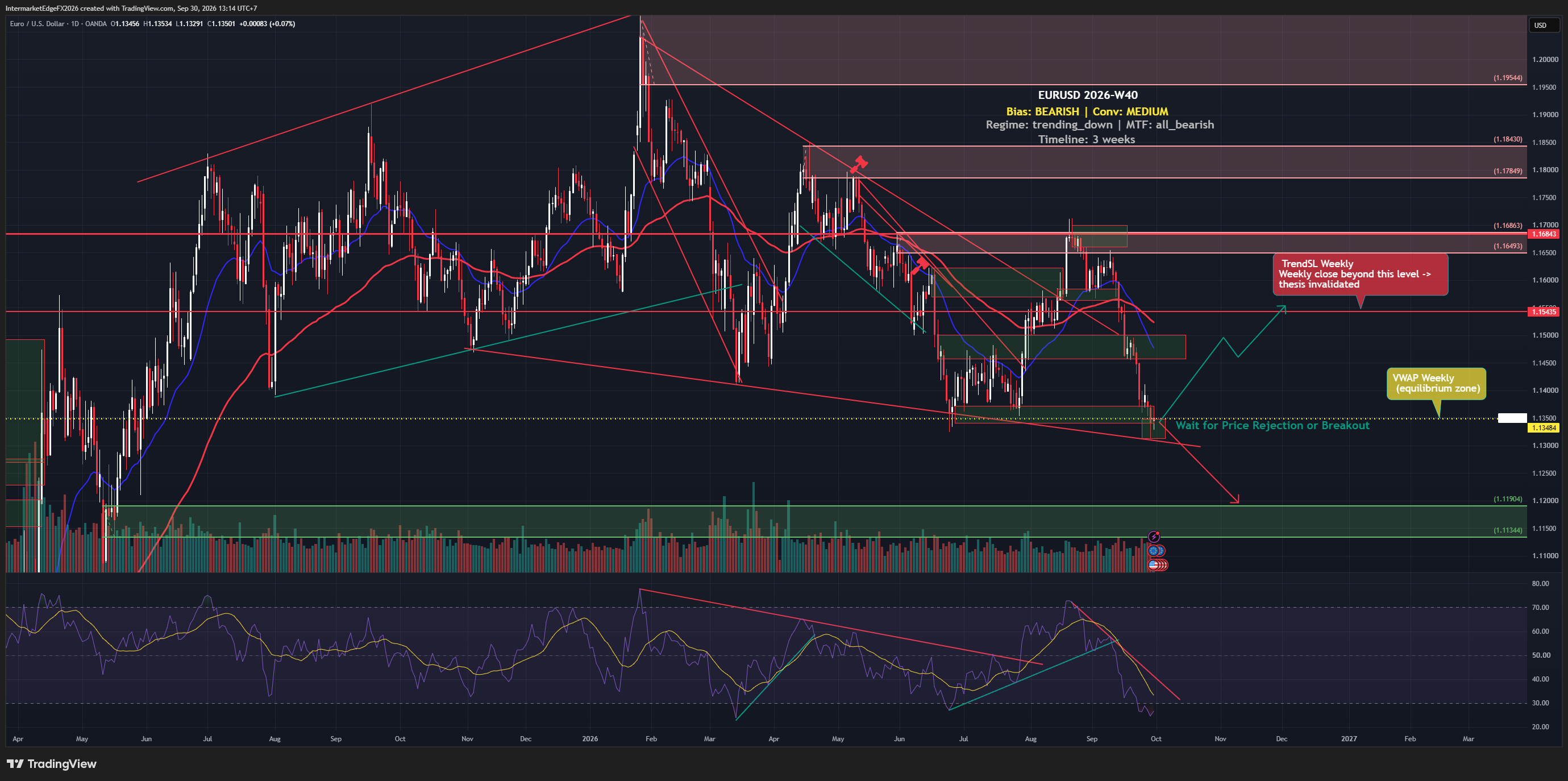
EURUSD is trading at 1.134 as of Wednesday, 30 September 2026, capping a month that Reuters confirms was the dollar's largest September gain, predominantly at the euro's expense. New York Fed President Williams has left the door open for one more rate hike this year, and with US 10-year real yields at 2.9%, the interest-rate math continues to favor the dollar structurally. The trend is down across every timeframe, but signal conflicts mean the path isn't as clean as the headline suggests. The bearish case on EURUSD rests primarily on the rate differential and the Fed's demonstrated willingness to keep it wide. When one central bank is signaling additional tightening while the other faces structurally slower growth and a different inflation profile, the currency on the higher-yield side tends to attract demand, and that demand compounds over weeks, not sessions. Reuters confirming the dollar's outsized September gain at the euro's expense is not just a data point; it's confirmation that the macro argument has already been expressing itself in price. That said, this is a medium-conviction view, not a high-conviction one, and traders should weigh that carefully. The conflict worth naming directly: price action signals and COT positioning, which reflects the aggregate stance of large futures traders, though the specific report week and net-position figures are not available here, so treat it as directional context rather than a precise citable stat, are both leaning bullish. When the macro framework points one direction and the market's actual positioning leans the other, the overall call carries more uncertainty than a clean trend setup would. The retail picture adds a contrarian lean: 72% of retail EURUSD accounts tracked by FXSSI as of 30 September are net long, and historically, when retail crowds are this lopsided on a major pair, it tends to lean against their position. -- Intermarket Edge

DXY Week W40-2026: Every Timeframe Points Up, Yet the Framework Calls Bearish — Who Is Wrong?

DXY Week W40-2026: Every Timeframe Points Up, Yet the Framework Calls Bearish — Who Is Wrong?

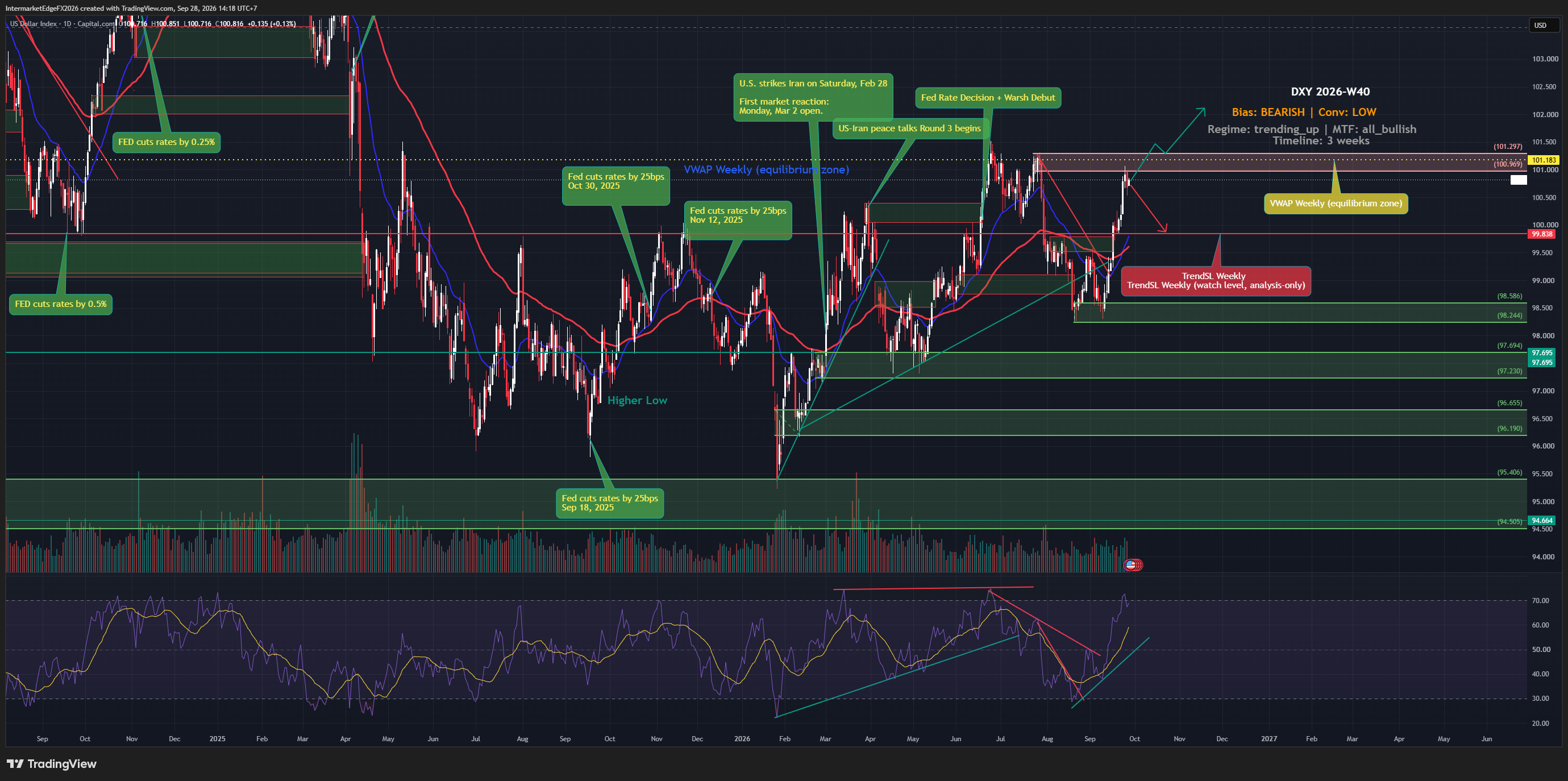
DXY W40: bullish structure challenges a low-conviction bearish bias. The framework remains bearish over a three-week horizon, but daily, weekly, and monthly technical signals are bullish. At 07:01 UTC on Monday, September 28, DXY was 101.188, testing the weekly VWAP area at 101.183 and remaining above the weekly TrendSL at 99.838. Reuters reports that US-Iran tensions are lifting oil while hawkish Fed expectations and Treasury yields are rising. That mix currently supports the dollar counter-case. The COT information in the brief lacks the report week, release date, CFTC code, and net-position figure, so it is directional context only and cannot confirm a current flow or trade trigger. A sustained reclaim of 101.183 would add near-term pressure against the bearish thesis. A completed weekly close below 99.838 would provide the first bearish structural confirmation; that condition remains pending. Core PCE and Final GDP are scheduled for September 30, followed by payrolls, earnings, and unemployment data on October 2, according to ForexFactory. These releases may change rate expectations, but their outcomes are still unknown. The practical decision is to wait for price or macro evidence to resolve the conflict rather than treat the bearish label as a standalone trade signal. Reference price: 101.188 at 07:01 UTC on September 28, 2026; source yfinance:DX-Y.NYB:1m. Educational content only.

DXY W39: Price Strength Challenges the Bearish Macro View

DXY W39: Price Strength Challenges the Bearish Macro View

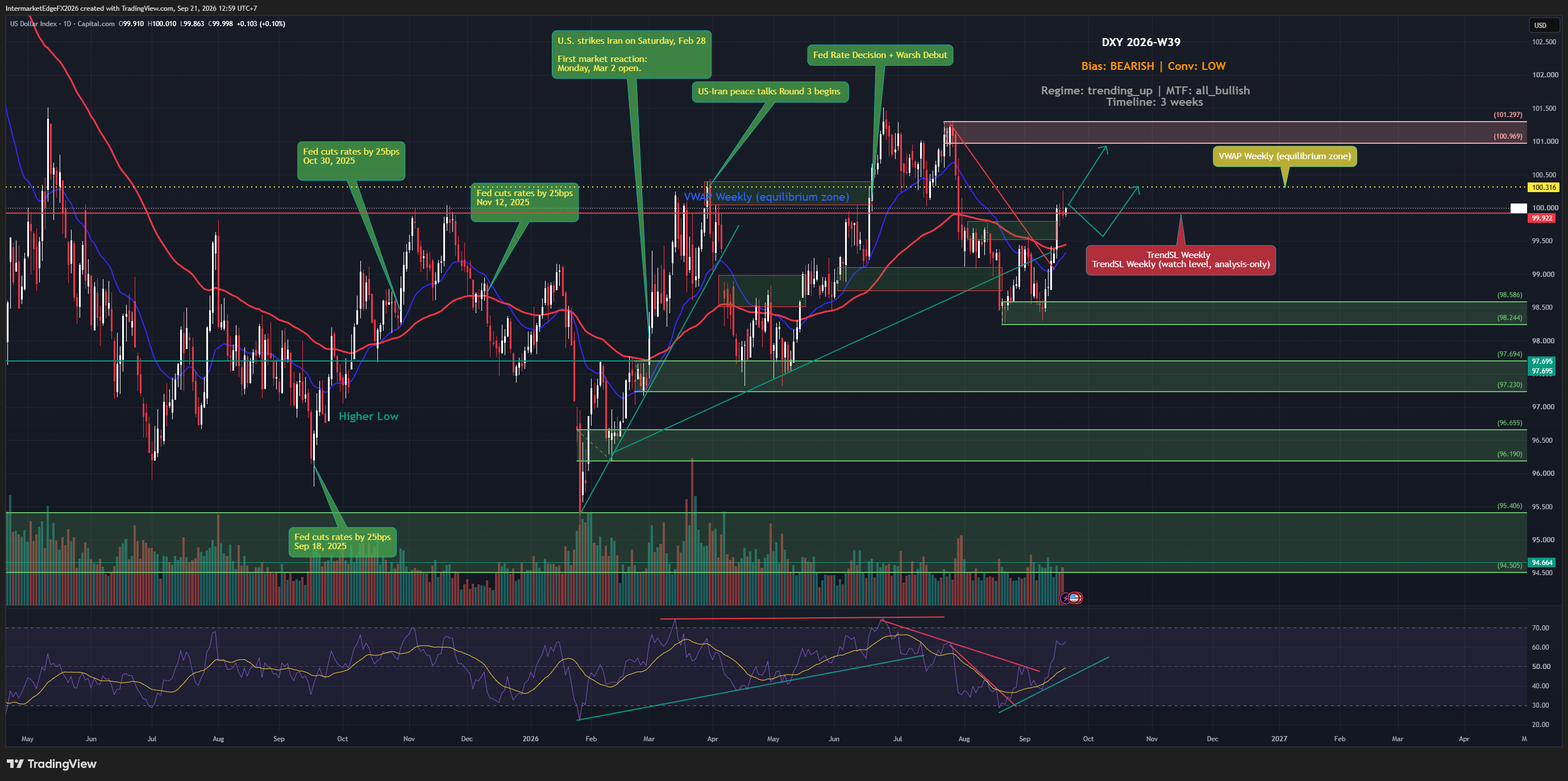
DXY W39: NEXUS leans bearish with low confidence over three weeks, while daily, weekly and monthly technical readings remain upward. At 100.344, price is above weekly VWAP 100.316 and weekly TrendSL 99.922. The watch condition against the bearish thesis is already active; one quote does not establish a sustained breakout. Schmid's inflation message supports policy restraint, while weaker US manufacturing provides a counterweight. The BOJ increased rates to 1.25% on 18 September. Reported Japanese rate checks are not confirmed intervention. Sustained oil-price relief could ease part of the inflation pressure. If DXY closes the week below TrendSL 99.922, that would provide bearish structural confirmation. It has not occurred. Continued strength above VWAP would challenge the bearish view. Wait for clearer evidence. Reference: DXY 100.344 at 05:46 UTC, 21 September 2026; source yfinance:DX-Y.NYB:1m. This is a timestamped reference, not a live quote at reading time. Weekly VWAP 100.316 and TrendSL 99.922 are the stored thesis levels. Intermarket Edge | Educational analysis.

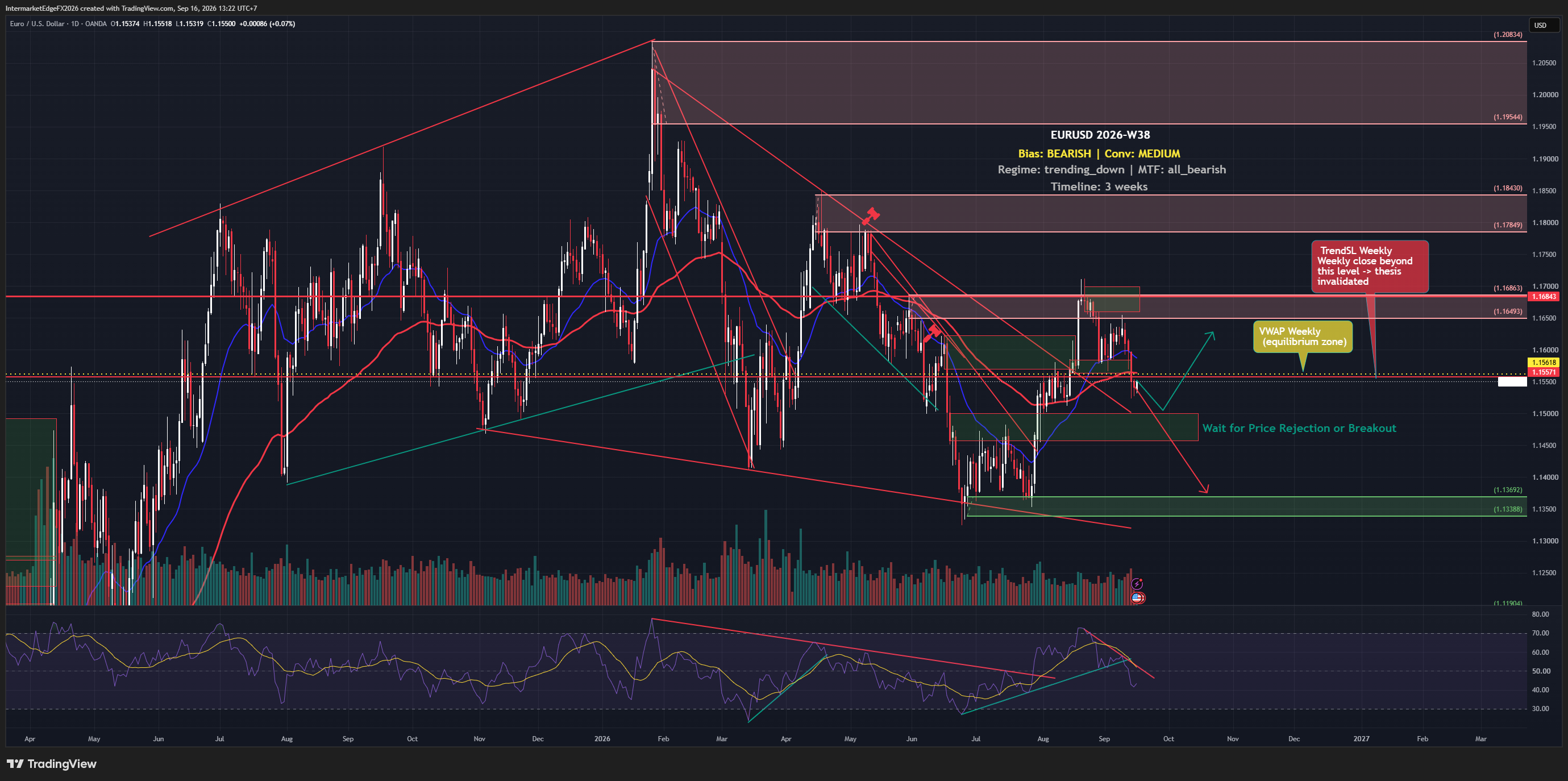
EURUSD Week W38-2026: Fed Pushes 10-Year Yields Toward 5%, But the Bearish Trade Is Harder to Execute Than It Looks

EURUSD Week W38-2026: Fed Pushes 10-Year Yields Toward 5%, But the Bearish Trade Is Harder to Execute Than It Looks

The ECB raised rates on September 10, and EURUSD is still trading near a one-month low. That disconnect is the story this week. With the US 10-year yield touching its highest level since 2007 and markets near-certain of another Fed hike on September 16, the rate differential, the yield gap that makes one currency more attractive to hold than the other, is doing the heavy lifting for the dollar. The euro got its hike; the dollar got the momentum. The bearish case for EURUSD this week rests on a clear causal chain: a Fed committed to higher-for-longer rates, rising real yields, and a rate differential that still favors the dollar over the euro even after the ECB's September 10 hike. That differential, measured not just by nominal policy rates but by the 2.6% real yield on US 10-year Treasuries, creates structural incentive to hold dollars, which means selling euros to fund that position. Every time that real yield anchors higher, the cost of being long EURUSD increases for an unhedged holder. What makes this week's setup genuinely uncertain, and why the conviction here is deliberate rather than high, is the conflict between the structural bearish overlay and several component-level signals that lean the other way. Price action itself has been constructive in recent sessions. COT positioning, non-commercial futures data showing which way large speculators are leaning, noting that the brief does not specify the exact report week or net-position figure, so this should be read as a directional lean rather than a precise statistic, shows a bullish tilt. And the macro component, somewhat counterintuitively, also scores bullish when isolated from the structural overlay. These three factors do not individually override the rate-differential thesis, but together they raise the cost of conviction. -- Intermarket Edge

Stay in the loop

Get notified about new research, macro insights, and market analysis.

InterMarketEdge

© 2026 InterMarketEdge. Financial intelligence for inter-market traders.