Articles — InterMarketEdge

Articles

Financial intelligence, macro research, and inter-market analysis.

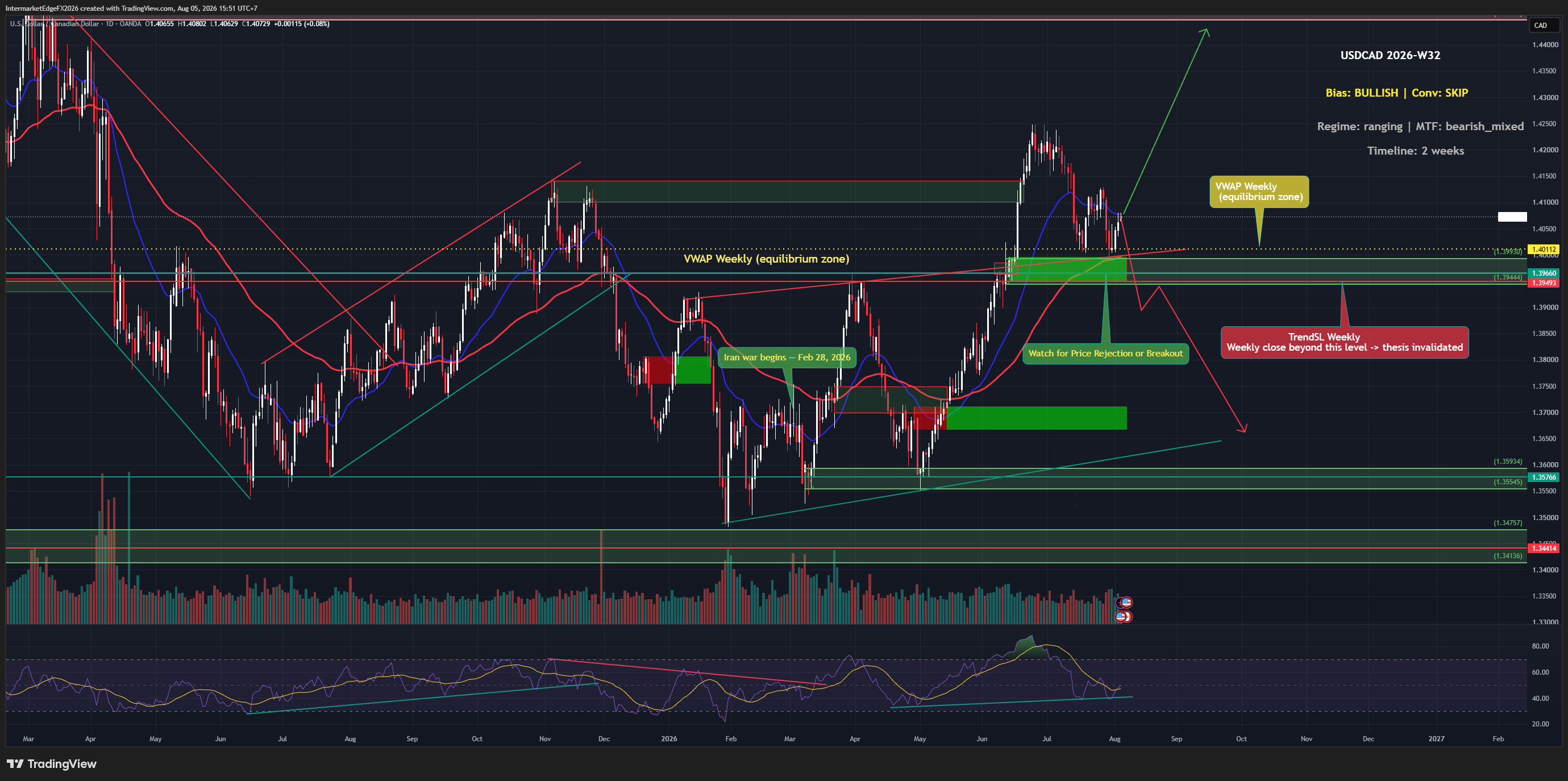
USDCAD Week W32-2026: Canadian Dollar Hits Six-Day Low as Oil Drops and Dollar Steadies Near 1.40665, but Bearish DXY Bias Keeps the Bull Case Fragile

USDCAD Week W32-2026: Canadian Dollar Hits Six-Day Low as Oil Drops and Dollar Steadies Near 1.40665, but Bearish DXY Bias Keeps the Bull Case Fragile

USDCAD is trading at 1.40665 as of Wednesday, 05 August 2026 at 08:31 UTC, holding above its weekly VWAP of 1.40112 even as the broader dollar faces pressure from Yen intervention spillover and Middle East-driven risk sentiment. The Canadian dollar recently hit a six-day low as oil prices dropped, lending short-term support to the pair. The bullish bias this week is real but fragile, conviction is low, the regime is ranging, and the macro case rests almost entirely on Fed hawkishness and rising real yields rather than any confirmed price-action breakout. The directional bias for USDCAD in Week W32-2026 is bullish, but conviction is low, a designation that carries real practical meaning for position sizing and risk management. The two active drivers supporting the upside case are COT positioning, which is skewed bullish (note: the brief does not specify the exact report week, net-position figure, or release date for this COT reading, so it should be treated as directional evidence rather than a standalone statistic), and macro fundamentals, specifically the Fed's hawkish stance and rising US real yields. The causal chain runs as follows: a hawkish Fed holding rates elevated or signaling further tightening pushes US real yields higher, which widens the rate differential between USD and CAD, making dollar-denominated assets relatively more attractive and supporting USDCAD. This is a coherent and well-established transmission mechanism in FX. However, the bullish case has a critical structural weakness: price action itself is not confirming the thesis. Momentum, liquidity, and sentiment signals are all neutral this week, meaning the market is not yet pricing in the macro story with any conviction. The multi-timeframe alignment is bearish-mixed, which is a direct caution flag, lower timeframes are not aligned with the weekly directional call. -- Intermarket Edge
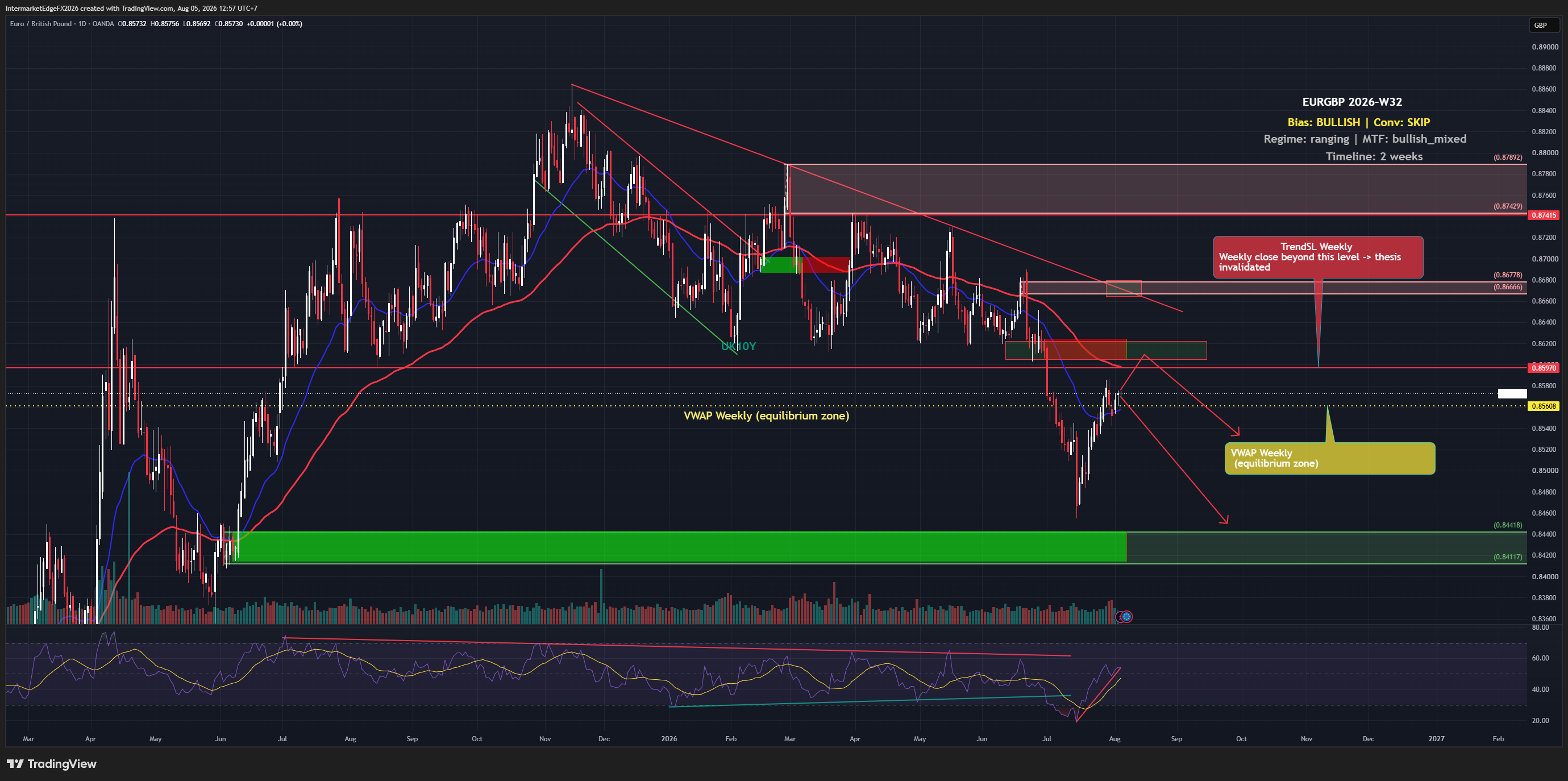
EURGBP Week W32-2026: BOE Holds at 3.75% but Bailey Pushes Back on Hike Bets, Price Tests From Underneath TrendSL 0.8597 With Conviction Too Thin to Chase

EURGBP Week W32-2026: BOE Holds at 3.75% but Bailey Pushes Back on Hike Bets, Price Tests From Underneath TrendSL 0.8597 With Conviction Too Thin to Chase

EURGBP is flashing a nominal bullish bias this week, but the setup is paper-thin. The Bank of England held rates at 3.75% on Wednesday 05 August 2026, and Governor Bailey went out of his way to shut down hike speculation, yet sterling is barely moving. With conviction at skip level and the technical structure already contradicting the directional label, this is one of those weeks where discipline means watching, not trading. The system flags a bullish bias on EURGBP for Week W32-2026, but the conviction level is explicitly rated as skip, meaning the framework itself is telling traders to stand aside rather than position. It is worth unpacking why the bullish label exists at all, and why it should be treated with significant scepticism. The sole active signal driving the directional tilt is price action; contributions from commitments of traders positioning, macro data, liquidity conditions, and sentiment are all neutral, registering zero weight. That means the bullish thesis rests on a single, thin pillar with no corroborating evidence from any other analytical lens. The stated primary driver is the ECB versus BOE rate differential, a legitimate structural theme in principle, but no macro or positioning rules have fired to confirm this narrative in the current week. There is a direct conflict between the cited driver and the absence of any supporting data firing in its favour, which should give traders real pause. Adding to the complexity, the eurozone core CPI miss removes a near-term catalyst for ECB hawkishness, while Bailey's explicit pushback on BOE hike expectations muddies the rate-differential story from the other side. Structural bias is assessed as neutral, which further undermines the weak bullish lean. -- Intermarket Edge

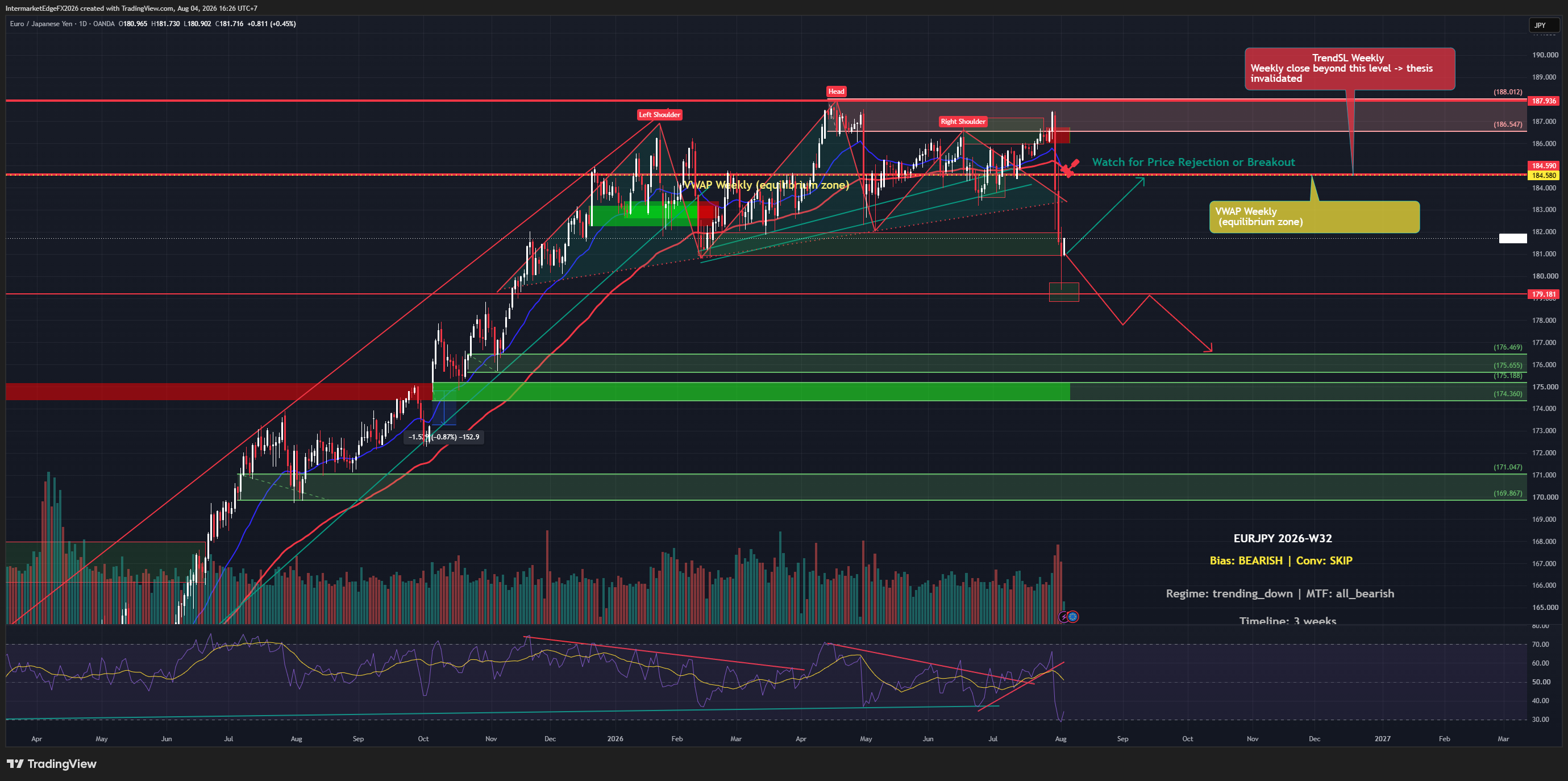
EURJPY Week W32-2026: US Yen-Buying Intervention Drives Price Below 184.58 VWAP as BOJ Holds at 1% and Flags Further Hike

EURJPY Week W32-2026: US Yen-Buying Intervention Drives Price Below 184.58 VWAP as BOJ Holds at 1% and Flags Further Hike

EURJPY is trading at 181.67 as of Tuesday, 04 August 2026, 09:09 UTC, nearly 3 full points below the weekly VWAP of 184.58, after the US shook currency markets by buying yen directly through euro sales. The BOJ held its overnight rate at 1% but reiterated its hiking path, keeping carry-unwind pressure alive. The multi-timeframe picture is all-bearish, yet conflicting signals between price action and macro mean conviction sits at skip level: the trend is real, but the evidence base is thin. The overall bias for EURJPY in Week W32-2026 is bearish, but the conviction level is explicitly rated skip, meaning the signal exists, but the evidence base is too thin and too conflicted to support a high-confidence directional trade. Let that framing govern everything that follows. The primary bearish driver is structural: BOJ hawkishness, reinforced by this week's hold-with-hike-guidance, pressures the rate differential that underpins euro-yen carry positioning. When the BOJ signals continued tightening while the ECB faces disinflationary data, the carry unwind dynamic, where traders exit long-EURJPY positions funded by cheap yen borrowing, becomes a credible medium-term force. The US intervention reported this week, specifically buying yen through euro sales rather than through the conventional dollar channel, is an unusually direct policy statement that adds event-driven downside pressure on top of the structural story. The regime is classified as trending down with moderate confidence, and the multi-timeframe alignment reads all-bearish, which in isolation would support a trend-follow posture. However, the thesis-level signal contains a direct conflict: price action scores bullish while the macro overlay scores bearish, producing a weak net bearish read with very low conviction overall. -- Intermarket Edge

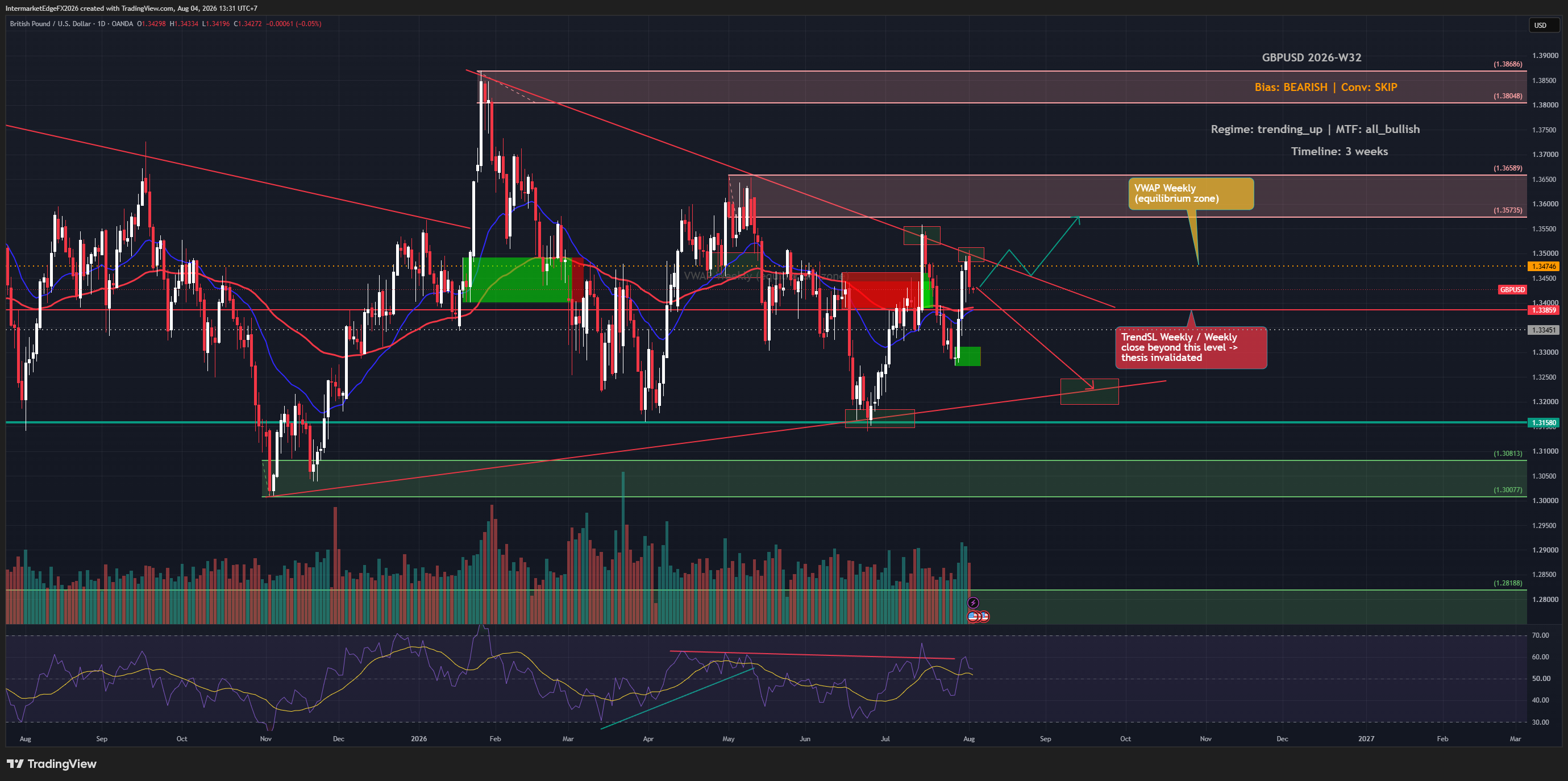
GBPUSD Week W32-2026: Sterling Slips Below 1.35 Despite Broad Dollar Weakness, Bearish Label Undercut by All-Bullish Technical Alignment Above TrendSL 1.33859

GBPUSD Week W32-2026: Sterling Slips Below 1.35 Despite Broad Dollar Weakness, Bearish Label Undercut by All-Bullish Technical Alignment Above TrendSL 1.33859

GBPUSD is caught in a genuine tug-of-war this week. The pound has slipped below 1.3500 despite broader dollar weakness, and the technical regime remains firmly bullish, yet macro headwinds from a hawkish Fed, rising real yields, and crowded long positioning in the futures market are building a credible case for downside. The honest read here is that this setup is too conflicted for a clean directional trade, and forcing a bias in either direction would be a mistake. The formal bias on GBPUSD for Week W32-2026 is bearish, but the conviction level is explicitly rated as skip, meaning this is not a setup where a position is warranted, and traders should treat that designation seriously rather than looking for a way to rationalize an entry. The bearish case rests on three macro causal chains that each carry meaningful weight: a hawkish Fed posture pushing USD higher, the core CPI miss notwithstanding; the structural linkage between DXY strength and GBPUSD downside; and Treasury General Account refill dynamics that drain liquidity from the banking system and tighten credit conditions, creating an indirect headwind for risk-correlated assets including sterling. The rate differential between the BoE and the Fed remains a focal point, if the Fed holds rates elevated while the BoE pivots or pauses, the interest rate carry shifts against GBP/USD longs over a multi-week horizon. That said, the bullish signals are not noise to be dismissed. Multi-timeframe alignment is fully bullish, price action over the recent sessions has been constructive, and the macro read independently scores bullish given pound strength driven by lingering rate-hike expectations. COT data shows speculator positioning leaning bearish, but the brief does not specify the exact report week, net-position figure, or release date, so this should be read as directional evidence rather than a precise, citable statistic. -- Intermarket Edge

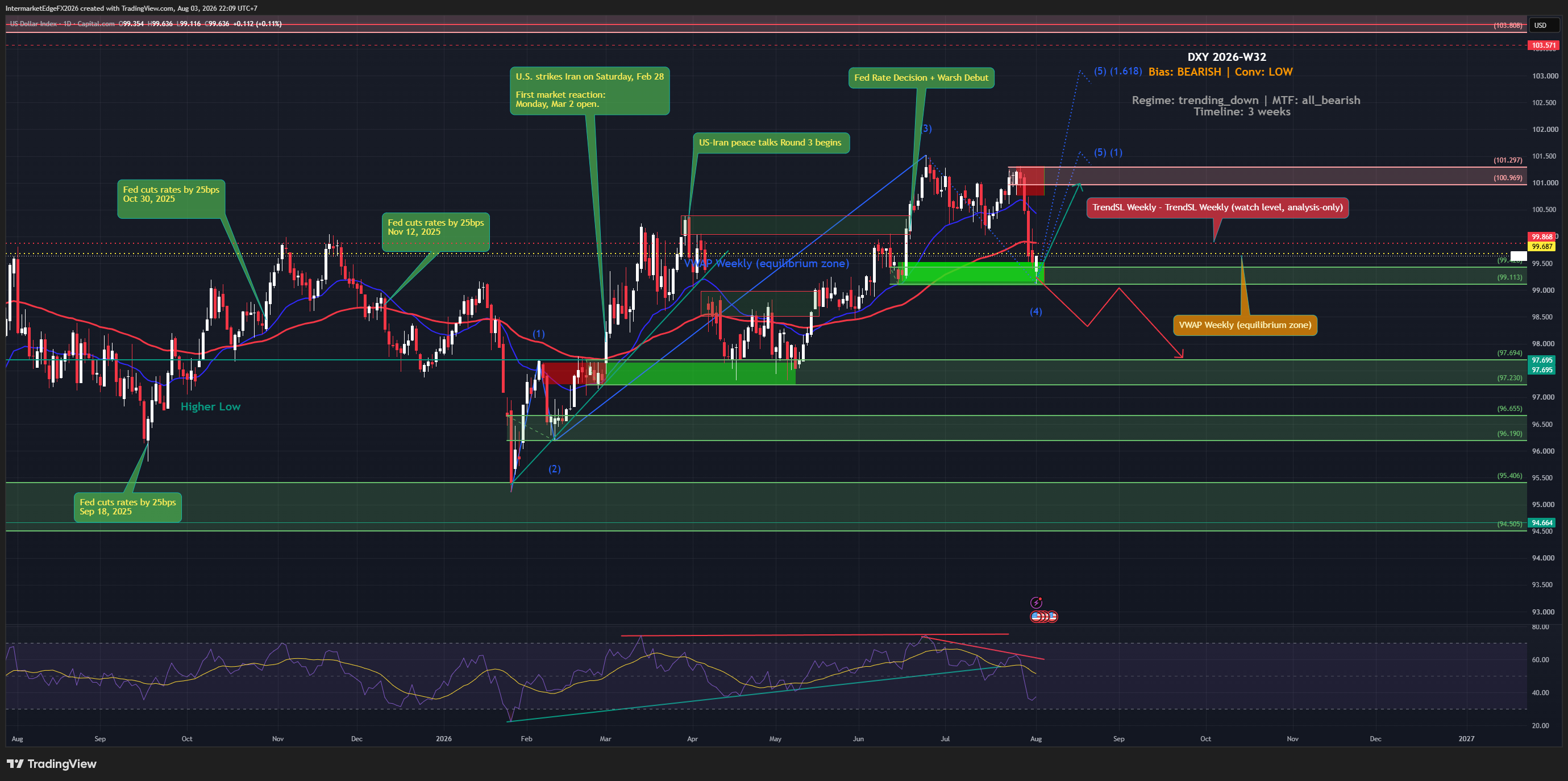
DXY Week W32-2026: ISM Manufacturing Surges to 55.6 as Dollar Tests VWAP at 99.687 From Above, But Macro Signal Conflict Keeps Bears Cautious

DXY Week W32-2026: ISM Manufacturing Surges to 55.6 as Dollar Tests VWAP at 99.687 From Above, But Macro Signal Conflict Keeps Bears Cautious

The US Dollar Index is under a trending bearish regime heading into Week W32-2026, yet the setup is anything but clean. Manufacturing activity just printed its strongest reading since May 2022, core CPI missed forecasts badly, and price is currently pressing against a critical structural level, all while the overall bias remains bearish with low conviction. This is a week for watching and assessing, not for forcing a position. The overall bias on DXY for Week W32-2026 is bearish, but conviction is explicitly low, and traders must handle this carefully. The multi-timeframe technical regime is aligned bearish across all timeframes, and the broader trend regime is classified as trending down with moderate confidence. That said, the signal picture is heavily conflicted. Both price action and the macro backdrop are currently pointing toward Dollar strength, the ISM beat, the still-elevated real yield of 2.41%, and the active causal chains around Fed policy relative to the G6 central bank basket and the residual influence of the prior hot inflation environment all argue for USD resilience. The rule engine's bearish override is driven by Fed policy divergence assessed relative to the broader G6 central bank basket, not by any single domestic data point, and it represents a structural thesis rather than a tactical one. Critically, three of five signal input categories, positioning data, liquidity indicators, and sentiment surveys, fired zero confirming signals this week. That is not a minor gap; it means the bearish call is resting on a much narrower evidential base than would normally justify an active directional stance. A macro bullish signal is also present but flagged as a provisional placeholder, subject to override if positioning data aligns in future reports. -- Intermarket Edge

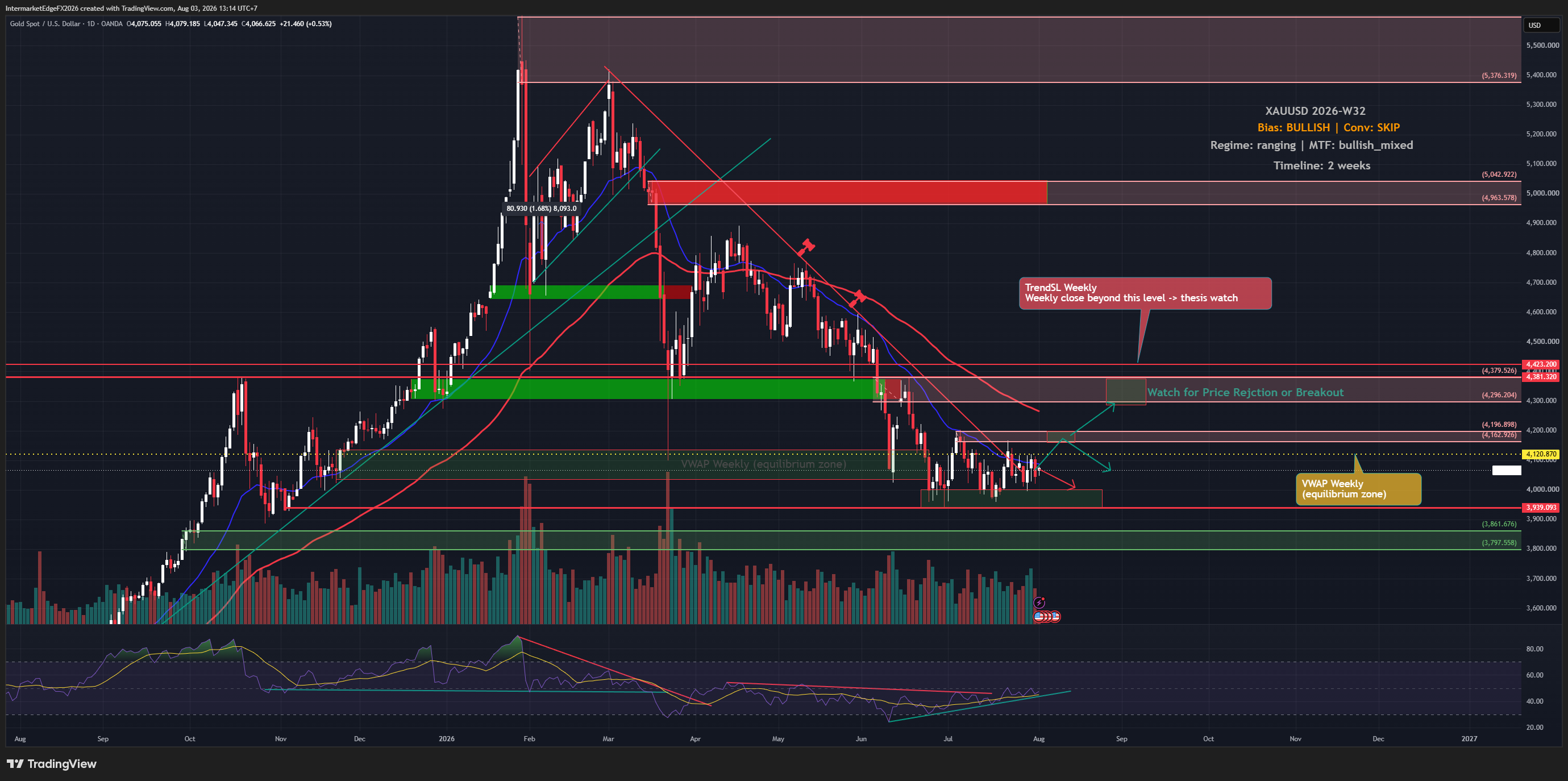
XAUUSD Week W32-2026: Gold Snaps Four-Month Losing Streak but Stalls Below VWAP 4120.87 as US-Iran Talks and a Core CPI Miss Send Conflicting Signals

XAUUSD Week W32-2026: Gold Snaps Four-Month Losing Streak but Stalls Below VWAP 4120.87 as US-Iran Talks and a Core CPI Miss Send Conflicting Signals

Gold just snapped a four-month losing streak, but the recovery is already showing cracks. As of Monday, 03 August 2026 at 05:50 UTC, XAUUSD on the GC=F futures contract used as proxy is trading at 4114.9, sitting below the weekly VWAP of 4120.87 and testing from underneath. The bullish label is technically alive, but the setup carries the lowest possible conviction rating this week, and the fundamental backdrop is genuinely conflicted. The formal bias for XAUUSD in Week W32-2026 is technically bullish, but traders need to understand exactly how weak that label is before acting on it. The bullish signal is being carried almost entirely by price action, no COT positioning signal, no liquidity signal, and no sentiment signal fired this week to provide corroborating evidence. The CFTC Commitments of Traders data for Comex Gold Futures and Options as of July 31 was noted in the news feed but contributed zero directional signal, which is itself meaningful: positioning is not lending support to the bullish case. It is important to note that COT data does not identify 'smart money' with precision, and the specific net-position figure, report week, and release date are not detailed in the available brief, so any inference from it should be treated cautiously. The macro contribution to the bullish score is minimal, and the active causal chains are openly conflicting: a hawkish Fed impulse driven by elevated real yields points in the bearish direction, while separate BOJ-hawkish and inflation-related signals send mixed cross-currents. The net result is that the fundamental backdrop is genuinely ambiguous, not simply unclear, the forces are offsetting rather than aligned. The ranging regime designation, assessed at 70% confidence, reinforces a mean-reversion FX implication, suggesting that sharp directional moves in either direction are statistically unlikely to sustain over the two-week horizon. -- Intermarket Edge

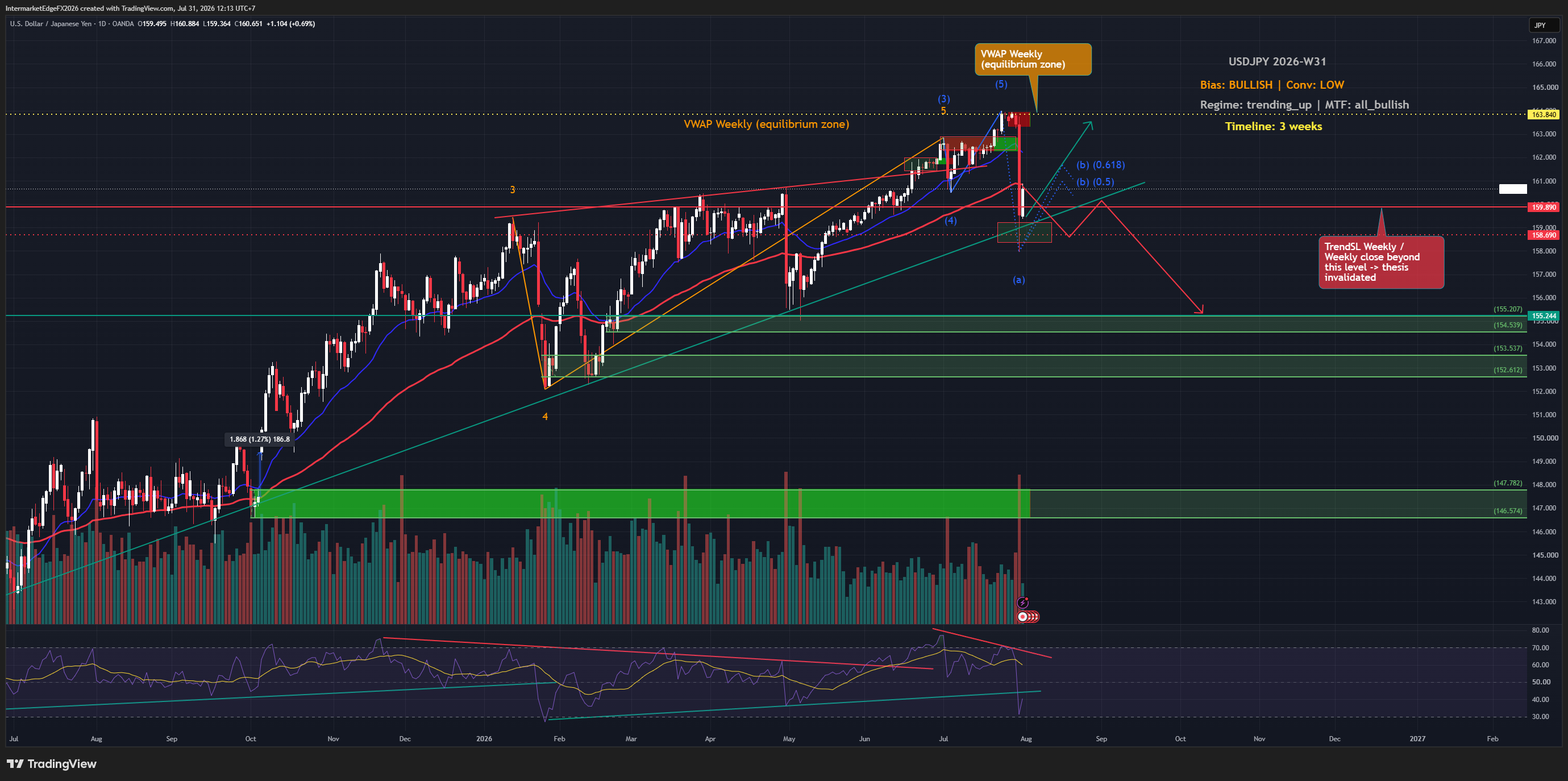
USDJPY Week W31-2026: BOJ Holds at 1% as Suspected FX Intervention Pushes Price Below VWAP 163.84, Bullish Trend Hangs by 0.77 Points Above TrendSL

USDJPY Week W31-2026: BOJ Holds at 1% as Suspected FX Intervention Pushes Price Below VWAP 163.84, Bullish Trend Hangs by 0.77 Points Above TrendSL

USDJPY is caught between two powerful forces this week: a Fed that remains hawkish with real yields elevated and a BOJ that just held rates at 1% while one board member openly pushed for a hike to 1.25%. As of Friday, 31 July 2026 at 05:00 UTC, price sits at 160.65, below the weekly VWAP of 163.84, with suspected FX intervention having already pushed the yen stronger. The bullish trend structure is intact, but short-term momentum is working against it. The overall bias on USDJPY for the 2026-W31 period is bullish, but conviction is low, low enough that the framework flags this as a 'skip' for active positioning, meaning conservative or zero sizing is the appropriate default, not an aggressive trend-following entry. The primary structural argument for the bullish bias is the Fed-versus-BOJ rate differential, which remains the most extreme divergence in the G7 currency space. The Fed is holding rates at elevated levels with a real yield of 2.43%, while the BOJ, even after five hikes this cycle, sits at just 1%, a gap that makes carry trades into yen-funded long-dollar positions structurally attractive when risk appetite is stable. The multi-timeframe technical trend alignment, daily, weekly, and monthly all pointing bullish, provides the strongest single input to this thesis and is the primary reason the bias is not outright neutral or bearish. However, a direct and unresolved signal conflict is present that traders must take seriously: the Fed hawkish causal chain pushes USDJPY higher through USD strength, while the BOJ hawkish chain, amplified by Takata's dissent and the suspected FX intervention, pushes USDJPY lower through JPY carry trade unwind. A carry unwind occurs when traders who borrowed yen cheaply to fund higher-yielding positions are forced or incentivized to close those trades, buying yen back and driving it higher against the dollar. -- Intermarket Edge

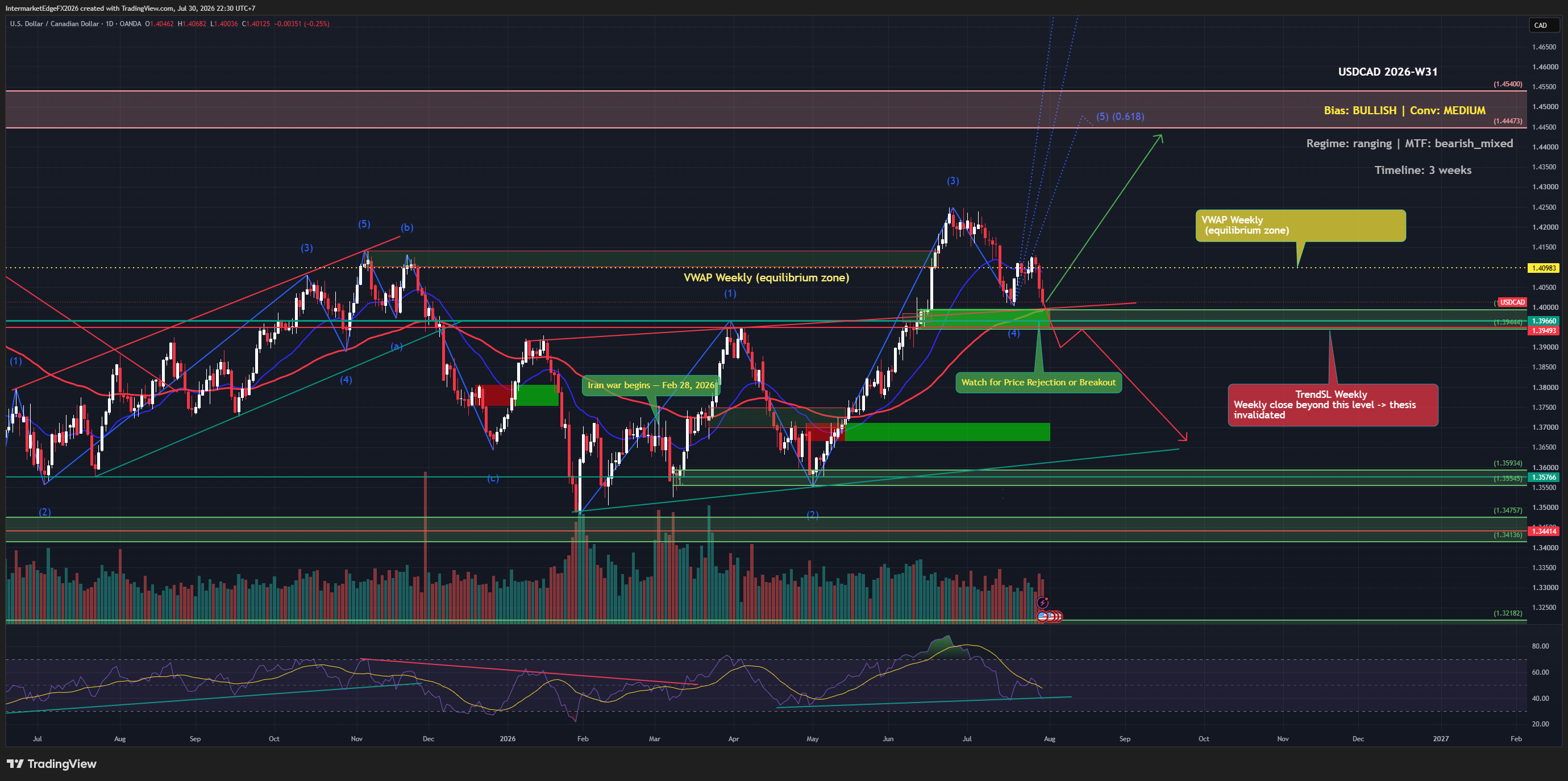
USDCAD Week W31-2026: Fed Holds Rates Steady and CAD Rallies to 9-Day High, Pushing Price Below VWAP at 1.40983 and Testing the Bullish Thesis

USDCAD Week W31-2026: Fed Holds Rates Steady and CAD Rallies to 9-Day High, Pushing Price Below VWAP at 1.40983 and Testing the Bullish Thesis

USDCAD is under immediate pressure after the Fed held rates steady, triggering a broad dollar slip and pushing the Canadian dollar to a 9-day high. As of Thursday, 30 July 2026 at 15:04 UTC, price sits at 1.40193, below the weekly VWAP of 1.40983, putting short-term momentum squarely against the bullish structural thesis. The longer-term trend structure remains intact above the weekly TrendSL at 1.39493, but bulls need to reclaim VWAP to restore confidence in the trend-follow setup. The medium-conviction bullish bias on USDCAD for the week of W31-2026 rests on three pillars: the Fed-versus-Bank-of-Canada rate differential, rising US real yields, and a multi-timeframe technical structure that remains aligned bullish across daily, weekly, and monthly frames. The rate differential argument is straightforward, with US real yields at 2.43% and the Fed maintaining a restrictive stance, the fundamental case for USD strength against a commodity-linked currency like CAD has not structurally deteriorated. COT positioning data available in the brief shows a bullish lean for this setup (though the specific report week, net-position figures, and sample context are not provided, so this should be treated as directional corroboration, not a standalone citable statistic). That said, conviction is explicitly rated at medium, not high, and the evidence base this week is narrower than ideal: no liquidity or sentiment signals fired, meaning the bullish case rests on price structure, COT direction, and macro fundamentals alone. The current market price of 1.40193 as of Thursday, 30 July 2026 at 15:04 UTC is already below the weekly VWAP of 1.40983, this is not a future contingency, it is the current reality, and it means short-term momentum is running against the bullish thesis right now. Position sizing should reflect this: this is not a moment to be adding to longs aggressively. -- Intermarket Edge

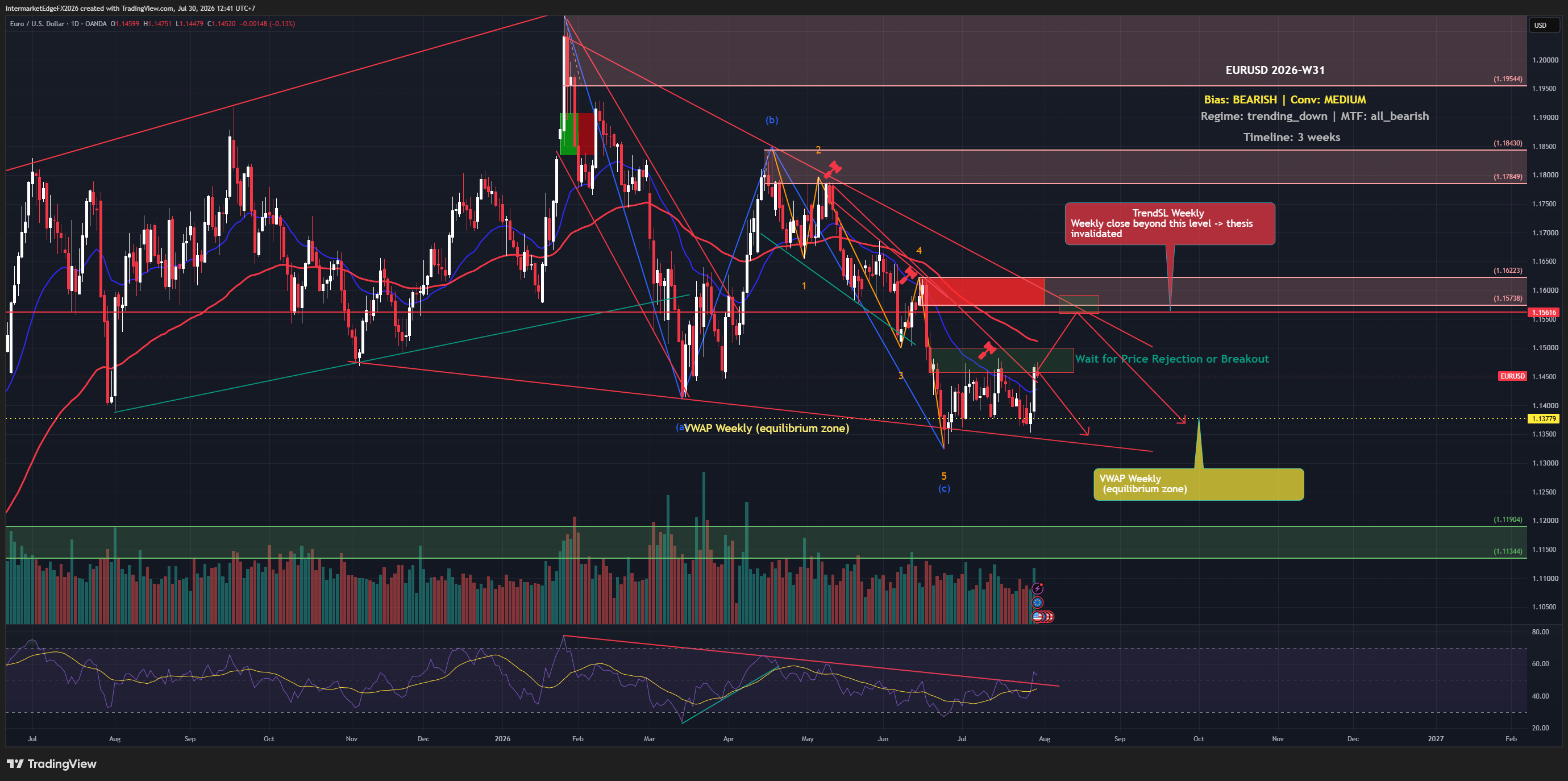
EURUSD Week W31-2026: Euro Climbs to Two-Week High as Fed Holds Rates Steady, Dollar Sinks and Bearish Thesis Faces Short-Term Counter-Trend Pressure

EURUSD Week W31-2026: Euro Climbs to Two-Week High as Fed Holds Rates Steady, Dollar Sinks and Bearish Thesis Faces Short-Term Counter-Trend Pressure

The Euro hit a two-week high this week as the Fed held rates steady and the dollar sank in the immediate aftermath, but don't mistake a short-term relief rally for a trend reversal. With US 10-year real yields running at 2.43% and the ECB-Fed rate differential still firmly favoring the dollar, the structural bearish case for EURUSD remains intact. The current bounce is trading against the macro grain, and that matters. The overall bias for EURUSD in W31-2026 is bearish with medium conviction, driven primarily by the ECB versus Fed rate differential that continues to favor USD strength across the medium-term horizon of roughly three weeks. The multi-timeframe technical alignment is fully bearish, every timeframe in the review is pointing in the same direction, which adds structural weight to the macro thesis even if short-term price action is temporarily running the other way. It is important to be explicit about the signal conflict present this week: both recent price action and COT positioning data are reading bullish, and the Euro is indeed trading above the weekly VWAP of 1.13779 as of Thursday, 30 July 2026 at 05:32 UTC. That is not a minor footnote, price at 1.14574 is already running against the thesis snapshot close, and that gap of roughly 80 pips is real counter-trend pressure that deserves respect. The COT signal showing net bullish positioning should also be noted, though the brief does not specify the exact report week, release date, or net contract figure, so it should be read as directional evidence rather than a precise citable statistic. The bearish thesis this week rests entirely on macro and causal-chain logic: Fed hawkishness feeds USD bullish pressure, which feeds EURUSD bearish pressure, with DXY directional weight being the strongest single input into the pair. -- Intermarket Edge

Stay in the loop

Get notified about new research, macro insights, and market analysis.

InterMarketEdge

© 2026 InterMarketEdge. Financial intelligence for inter-market traders.